This SVT-40 identification guide is a plain walk-through for reading arsenal marks, serial matching, and the Finnish “SA” capture stamp — including the fake-stamp problem every buyer should know about before paying a premium for one. Cousins (SVT-38, AVT-40) get a short callout.
Quick identification checklist
Work the rifle top to bottom before you decide what it “should” be.
- Receiver top — arsenal symbol plus a two-digit year. Star = Tula. Arrow-in-a-triangle = Izhevsk.
- Serial number — Cyrillic-prefix number on the receiver; compare against the bolt, charging handle/bolt carrier, trigger guard, and stock.
- Near the receiver — look for a boxed “SA” stamp (Finnish capture) and check it against the fakes notes below before trusting it.
- Import marks, if any — tell you about the US import chain, not the original Soviet production.
- Overall finish and wood — consistent wear and matching refinish patterns are a good sign; a pristine bolt on a well-worn stock is a flag.
What you’re looking at
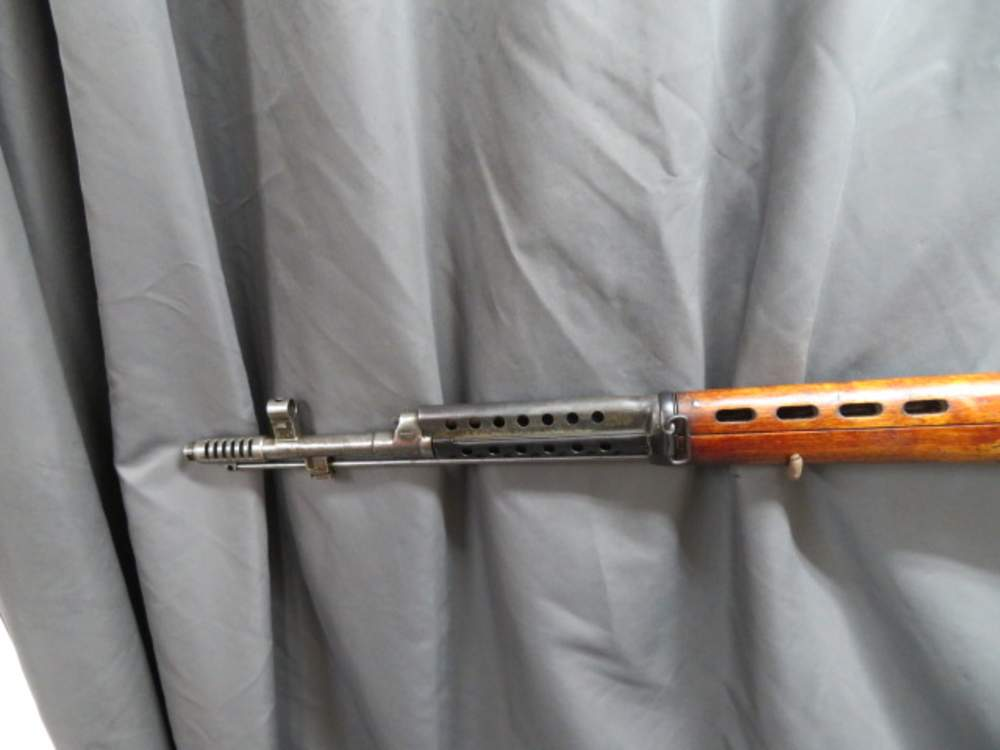
The SVT-40 (Samozaryadnaya Vintovka Tokareva, 1940 model) was the Soviet Union’s standard semi-automatic service rifle, chambered in 7.62x54mmR, adopted in 1940 as Fedor Tokarev’s refinement of his earlier SVT-38. Production ran through the war at multiple state arsenals, and the rifle saw its heaviest fighting on the Eastern Front before the simpler, more rugged Mosin-Nagant reclaimed priority in many units.
Arsenal marks
Every SVT-40 carries its manufacturing arsenal’s mark stamped near the chamber or on the receiver, alongside a year. Production ran across a small number of state arsenals (referenced by factory number in Soviet records, e.g. No. 314 NKV at Tula and No. 74 NKV at Izhevsk), but collectors identify them by the arsenal mark itself:
| Arsenal | Mark | Notes |
|---|---|---|
| Tula | Star, over the year | One of the two primary SVT-40 arsenals |
| Izhevsk | Arrow inside a triangle, over the year | The other primary arsenal; genuinely scarce compared to Tula production |
If you’re unsure which arsenal made a specific rifle from a low-quality photo, don’t guess — a reference book or an experienced collector’s eye is worth more than a confident-sounding assumption.
Serial numbers & matching parts
The serial is a Cyrillic-letter-prefixed number stamped on the left side of the receiver. On an all-matching rifle, the same number (or its last few digits) should also appear on the bolt, the charging handle/bolt carrier, the trigger guard, and often the left side of the stock. Mismatched numbers don’t automatically mean a fake — they usually mean the rifle passed through a Soviet arsenal rebuild or had parts swapped during its service life — but all-matching examples are generally the more desirable (and valuable) find.
Finnish capture & the SA stamp
This is the mark with the most interesting story, and the one that needs the most care. Finnish forces captured real numbers of SVT-40s during the Winter War and Continuation War, and rifles taken into Finnish Army service were marked with a boxed “SA” stamp (Suomen Armeija — Finnish Army).
One detail that surprises a lot of buyers: SA marking wasn’t necessarily applied the moment a rifle was captured. Most Finnish-capture SVTs only received the SA stamp later, when the rifle passed through a repair depot for overhaul and long-term storage — so the presence or absence of the stamp isn’t purely a battlefield-capture question, it’s tied to that rifle’s specific depot history.
Fakes & what to watch for
Be direct with yourself about this one: the SA stamp has real collector premium attached to it, and that has made it a genuine target for fraud. Collector forums have documented and warned about fake SA stamping dies circulating in North America since the early 2000s — rifles (including some cut-down/sporterized SVTs with no real Finnish history) stamped after the fact and sold to buyers who didn’t know to check. There have also been reproduction SVT-40s made in Finland in the 1990s that were sold into the collector market as originals.
Practical takeaways:
- An SA stamp alone isn’t proof. Look at the stamp’s style, depth, and placement against verified reference examples, and weigh the rifle’s overall condition and other markings as corroborating (or contradicting) evidence.
- Genuine Finnish-capture rifles typically show no US import marks, since they generally didn’t come to the US through the standard commercial-import pipeline the way German or other captured weapons did.
- If a deal on an “SA-marked” SVT-40 looks too good, or the stamp looks suspiciously crisp on an otherwise well-worn rifle, slow down and get a second opinion before paying the Finnish-capture premium.
Cousins: SVT-38 and AVT-40
The SVT-40 is a refinement of the earlier SVT-38 — Tokarev’s original 1938 design, with a simplified stock, muzzle brake, and disassembly procedure on the later gun. A related variant, the AVT-40, added a selector for automatic fire and is visually similar but mechanically distinct — don’t assume every SVT-pattern rifle is semi-auto-only without checking for a selector.
Sources
- Tokarev SVT-40: Identifying, Collecting and FAQ — Gunboards Forums
- SVT-40 Tokarev semi-auto rifle — m9130.info
- This Old Gun: Finnish-Capture SVT-40 — American Rifleman (NRA)
- Beware, Fake Finnish [SA] Stamp — Gunboards Forums
Collector reference and forum sources, cross-checked across multiple threads. Treat specific serial-range and production-quantity claims as estimates, not certainties — original wartime Soviet production records are incomplete.
Want the fuller story behind the SVT-40’s design and service history? Read our SVT-40 Tokarev Rifle history piece, or browse current inventory.
Markings That Matter for Authentication
Beyond the basic arsenal markings, several other markings and features deserve a close look when you’re evaluating an SVT-40’s originality and history:
- Matching factory serials: Check that the receiver, bolt, bolt carrier, stock, and dust cover (where numbered) all carry the same serial number. Electro-penciled numbers usually mean the parts were force-matched during arsenal refurbishment, which is different from original factory-stamped matching numbers.
- Finnish SA capture stamps: SA stamps are Finnish capture markings and identify a rifle that passed into Finnish hands. Finn-marked rifles turn up both in original capture condition and in refurbished condition, so check the rest of the rifle for signs of later refurbishment.
- Arsenal of manufacture (Tula vs Izhevsk): SVT-40s were made at both Tula and Izhevsk, and Tula rifles are identified by the Tula star marking. Most examples found in the U.S. are Tula-made, and Izhevsk rifles are less common.
- Early 1940-41 features: Some early 1940-41 receivers have scope-rail grooves. Rail grooves alone do not identify a sniper rifle, because a genuine sniper receiver also has the sniper notch.
- Sniper notch with matching PU/PEM mount and scope: A genuine SVT-40 sniper rifle has the sniper notch along with a PU or PEM mount and scope that match the rifle. Confirm that the notch, mount, and scope all belong together as one system rather than being assembled later.
Free for collectors: Is your K98k original? Get the 5-point check.
One page, about ten minutes, with the receiver ring codes, Waffenamt stamps, matching numbers, and the signs of a rebuild. Sent to your email in seconds.