A plain walk-through for the FN FAL rifle family — how to read Belgian proof marks and manufacturer rollmarks, tell metric pattern from inch pattern at a glance, and separate a real military-contract FAL from a modern semi-auto build like DSA’s SA58.
Metric-pattern focus here, since that covers most Continental military contracts and current US-market builds. The inch-pattern Commonwealth L1A1 gets a comparison table below but its own maker-code deep dive waits for a later guide.
Worked example on site:
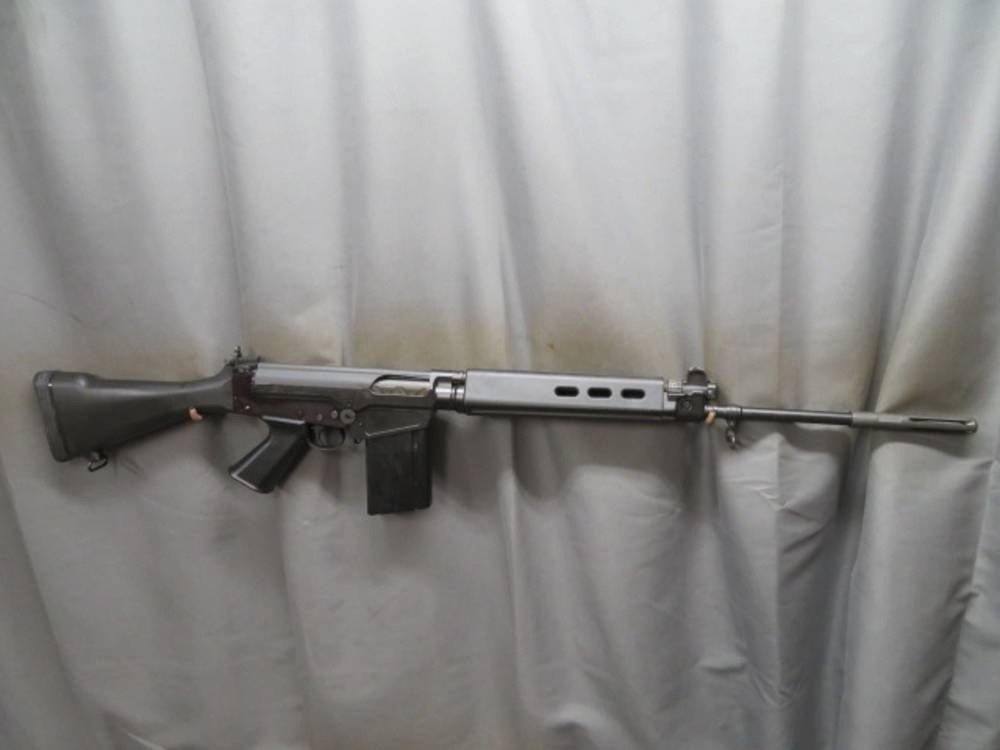
- Belgian FN FAL Rifle (SA58 Metric Pattern) — a current DSA-built metric-pattern SA58, the companion history piece to this guide.
Quick identification checklist
Work the rifle top to bottom. Write what you see before you decide what it “should” be.
- Caliber marking — 7.62×51mm NATO stamped on the receiver or barrel. Never assume from silhouette alone.
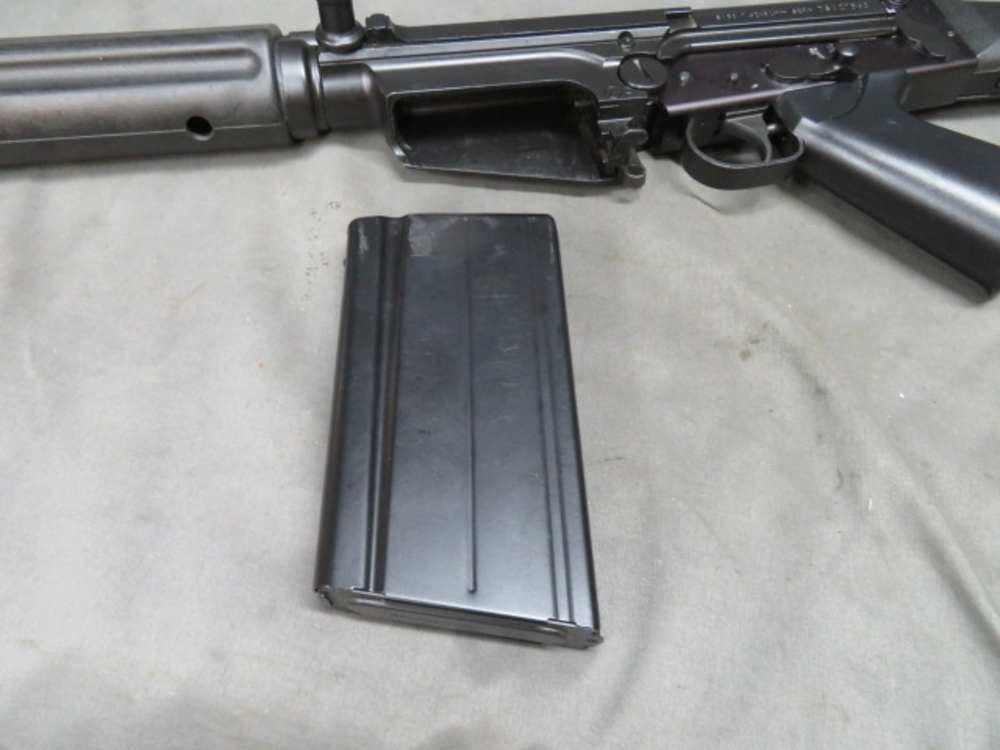
- Magazine well front cut — small dome-shaped indent = metric pattern; a wider rectangular slot = inch pattern (Commonwealth L1A1-type). This is the fastest single tell.
- Pistol grip fixing — metric grip is held by a nut from underneath; inch-pattern Commonwealth grip is bolted down through the top of the lower.
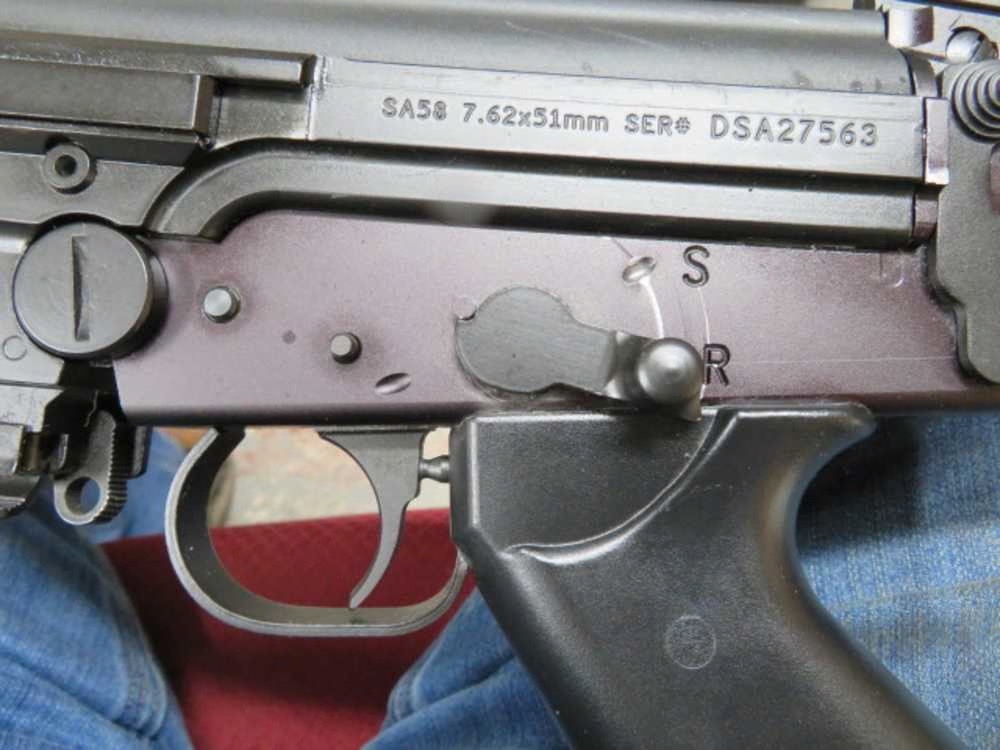
- Selector lever size — the inch-pattern Commonwealth selector is noticeably oversized compared to a metric selector.
- Receiver rollmarks — read the manufacturer name/location and model designation off one side, and the serial number off the other (or in the magazine well on some builds) — don’t assume country from furniture alone.
- Proof / acceptance marks — original Belgian military and commercial FN production carries Liège proof marks (crowned ELG, the Perron column). A licensed foreign-built or US semi-auto-built rifle carries that country’s or manufacturer’s own marks instead, not Belgian proofs.
- Build type — a demilled military-surplus parts kit rebuilt onto a US-made semi-auto-only receiver, vs. a factory-new commercial build (e.g., DSA’s SA58) — check the receiver’s own rollmark, not just the furniture, to tell which you have.
Then dig into the sections below.
What you’re looking at
The FN FAL (Fusil Automatique Léger, “Light Automatic Rifle”) is a gas-operated, tilting-block battle rifle designed by Fabrique Nationale Herstal in Belgium and chambered for 7.62×51mm NATO. Adopted and licensed by a wide range of NATO and allied countries through the Cold War, it earned the nickname “the right arm of the free world.” It lost out to smaller-caliber service rifles in most front-line NATO use by the 1980s but stayed in second-line, reserve, and export use for decades afterward — commonly cited production and country-adoption figures vary by source, so treat any single headline number as an estimate rather than a settled fact.
Collectors run into three very different kinds of FAL today: an original foreign military-contract rifle, a demilled parts kit rebuilt onto a US semi-auto receiver, and a factory-new commercial semi-auto rifle like DSA’s SA58. Start with the receiver’s own rollmark and proof marks — not the furniture or finish — to tell which one you have.
How to read the receiver
What’s stamped on the receiver depends entirely on who built it.
Original Belgian FN production
Every genuine FN Herstal product carries the mandatory Liège commercial proof marks: a crowned “ELG” in an oval (Épreuve Liégeoise Garantie — the main Belgian proof guarantee), the Perron — a small three-step-column mark representing a monument in Liège, used as an FN proof since 1853 — plus letter codes for bore rifling and powder type (smokeless vs. black powder proof). Belgian military-contract rifles additionally carry the Belgian lion-and-sword coat-of-arms with a year of adoption, and export-contract rifles carry the customer country’s own acceptance mark (for example, a kangaroo stamp on Australian-contract FALs). Verify against a photo or plate rather than reconstructing these marks from memory.
Modern US commercial builds (DSA SA58)
A current DSA-built receiver carries no Belgian proofs at all — instead it’s marked with DSA’s own rollmark. The standard pattern collectors report is “DSA INC. / LK BARRINGTON, IL” on one side of the receiver and “SA58 308 CAL SER#” followed by the serial number on the other. Some DSA receivers relocate the manufacturer markings into the magazine well instead, specifically to better match a historic military parts-kit build — those may also carry the original military designation (e.g., “STG58” or “Type 1 Carry Handle Cut”) alongside the SA58 model name.
Metric vs. inch pattern
FN’s original design is the metric pattern. The UK and Commonwealth reverse-engineered their own version to imperial (inch) dimensions, adopted as the L1A1 Self-Loading Rifle — built to different tolerances on several key parts, which are not generally interchangeable between the two patterns.
| Feature | Metric Pattern | Inch Pattern (Commonwealth L1A1) |
|---|---|---|
| Magazine well front cut | Small dome-shaped indent | Wider rectangular slot |
| Magazine engagement | Small stamped protrusion engages the receiver | Wider, heavier lip retains the front of the mag |
| Pistol grip fixing | Held by a nut from underneath | Bolted down through the top of the lower |
| Selector lever | Standard size | Noticeably oversized |
| Typical makers | FN (Belgium), Steyr (Austria), IMBEL (Brazil), FMAP/DGFM (Argentina), LIW (South Africa), DSA/Springfield Armory/Entreprise (USA, commercial) | UK, Australia, Canada, India, New Zealand, Singapore-produced L1A1 rifles |
DSA notably produces both — its SA58 line is metric pattern, while DSA also builds inch-pattern receivers marked L1A1. Don’t assume a DSA-marked receiver is automatically metric without checking the specific model marking.
Manufacturers and countries
The FAL was licensed to a wide range of countries during the Cold War — treat this as a representative list, not an exhaustive one.
| Country | Manufacturer | Local designation / notes |
|---|---|---|
| Belgium | FN Herstal | Original design and production |
| Austria | Steyr | StG 58, metric pattern |
| Brazil | IMBEL | LAR / Fz. M964, metric pattern, licensed |
| Argentina | DGFM (Fabricaciones Militares) | FALM IV (Fusil Automático Liviano Modelo IV), metric pattern |
| South Africa | Lyttleton Engineering Works | R1, metric pattern |
| Israel | IMI | Metric pattern, various local designations |
| Greece / Nigeria / Venezuela | Pyrkal / DICON / CAVIM | Licensed metric-pattern production |
| UK, Australia, Canada, India, New Zealand, Singapore | National arsenals (per country) | L1A1 Self-Loading Rifle, inch pattern |
| USA (modern commercial) | DSA, Springfield Armory (historic), Entreprise Arms | Semi-auto only; DSA’s SA58 (metric) and L1A1-marked (inch) lines |
DSA serial prefixes and modern builds
DSA (DS Arms, Lake Barrington, Illinois) is the major current US manufacturer of new-production metric-pattern FAL-type rifles under the SA58 name, alongside its own inch-pattern L1A1-marked line.
Collector forums commonly describe a serial-prefix split: rifles serialed with a “DS” prefix are typically forged receivers (reported to be forged for DSA by LMT), while a “DSA” prefix is typically an in-house cast receiver — the forged “DS” receivers are generally considered more desirable by collectors. Treat this as widely repeated collector knowledge rather than an officially published DSA specification, and confirm directly with DSA using the actual serial number if it matters for a specific rifle.
Dating and serial ranges
The FAL family doesn’t carry one universal year-stamp system the way some other military rifles do — the dating approach depends entirely on who built the specific rifle.
Original Belgian FN production: dating ties to the Liège proof date-letter cycle, which repeats every 25 years — the same letter recurs across different eras, so a single date letter doesn’t uniquely identify a year without also knowing which cycle applies. In 1972, Belgian authorities added a second serial number on the right side of the upper receiver, reflecting the rifle’s position within FN’s total FAL production run — worth checking for on any Belgian-made rifle from that era forward.
Modern DSA production: there’s no collector-facing date code equivalent to a WWII military rifle’s arsenal/year stamp. Some earlier DSA barrels carried their own date stamp, and current production reportedly uses a small two-digit date code stamped near the carry-handle cut on the charging-handle side of the receiver — treat that as one data point, not a guarantee, since it’s collector-reported rather than an officially published DSA spec. The reliable way to confirm an exact DSA manufacture date is calling DSA directly with the serial number.
Imports, parts kits, and configurations
Most FN FALs reaching US civilian hands did not arrive as war-trophy bringbacks the way a WWII-era rifle might — the type postdates WWII entirely. The common US path instead is a demilled military-surplus parts kit, built up onto a new US-manufactured semi-auto-only receiver, or a factory-new commercial semi-auto rifle like DSA’s SA58 built from all-new parts.
Federal law requires the original full-auto receiver be destroyed before a parts kit can be imported and sold — current ATF standard calls for three torch-cuts in specific locations, while older kits demilled under a prior single-saw-cut standard also still circulate. Never assume caliber or configuration from a parts kit’s country of origin alone — verify the actual chamber marking and measure before firing, same caution as any surplus-parts rebuild.
Rewelds, kit-gun cautions, and lookalikes
Rewelded demil receivers
This is the single biggest buyer caution on this platform — bigger than any faked proof mark. Welding a properly demilled machine-gun receiver back into a functional shape recreates a machine-gun receiver under federal law; collector forums treat this as settled fact, not a gray area. The FAL’s tilting-block locking design puts the locking shoulders at the rear of the receiver, which collectors note makes it a poor candidate for a strong reweld repair — so a rewelded receiver is a real safety concern on top of the legal one. Visible weld lines crossing a demil-cut area are a legal and safety red flag, not a cosmetic detail.
Kit-gun vs. factory build quality
A parts-kit rifle built onto a US semi-auto receiver varies widely in fit and finish depending on who did the build and which receiver/parts combination was used — it isn’t automatically equivalent to a factory-new commercial rifle like a DSA SA58. Confirm who actually assembled a specific rifle (a known commercial builder vs. a private kit build) before assuming build quality.
Metric/inch parts mixing
Because metric and inch-pattern parts are not generally interchangeable (see the comparison table above), a rifle assembled with a mismatched mix of the two patterns is a real functional concern, not just a collector-purity one. Confirm pattern consistency across the whole rifle, not just the receiver.
Cousin callouts (short)
Related or contemporary rifles that get confused with an FN FAL. Short notes only.
HK G3
West Germany’s contemporary Cold War-era NATO battle rifle rival — roller-delayed blowback rather than the FAL’s gas-operated tilting-block action. Visually distinguished by a stamped-sheet-metal receiver and a distinctive drum-style rear sight.
SIG SG 510 (Stgw 57)
Switzerland’s own contemporary battle rifle — unrelated in lineage, but similar-era wood-and-metal furniture occasionally confuses unfamiliar buyers.
L1A1 SLR
The inch-pattern Commonwealth cousin covered in the comparison table above. Its own identification guide — UK, Australian, Canadian, Indian, and New Zealand maker codes — waits for a later guide.
Steyr StG 58
Austria’s metric-pattern licensed FAL variant. DSA’s own “STG58” magazine-well marking option (noted above) references this specific military designation — it isn’t a separate rifle family, just a build variant of the same metric pattern.
Later guides
Standard metric-pattern FN FAL identification only here. A full inch-pattern L1A1 maker-code deep dive, and country-specific deep dives for Argentine, Brazilian IMBEL, and Israeli-built rifles, belong in later guides.
Sources
- Armament Research Services (ARES). ARES Field Guide No. 1: Identifying & Tracing the FN Herstal FAL Rifle. (identification/tracing overview; not page-checked line by line for this draft)
- Antique Gallery. Fabrique Nationale Herstal proof marks reference.
- The FAL Files. Belgian proof mark (Perron / ELG discussion).
- The FAL Files. DSA SA58 what is it? and StG 58 Serial Number and Production Date Survey (collector-reported serial prefix and date-code discussion).
- Gunboards Forums. DSA SA58 identification thread.
- Military Surplus Collectors Forums (milsurps.com). FAL magazine / metric vs. inch identification thread.
- DSArms.com. Current SA58/STG58 forged receiver listings (manufacturer rollmark and model-naming reference).
- Recoil Magazine (recoilweb.com). Israeli FAL Parts Kits Announced by DSArms (parts-kit/demil background).
- The FAL Files. Ever heard of upper receiver RE-Welds? (legal/safety consensus on demil rewelds).
- Wikipedia. FN FAL (orientation, licensed-country list).
- Eisel Armory Weapon History:
Further reading (optional shelf)
Classic collector reference. Not page-checked line by line for this draft and not a required gate before publish — useful shelf when you want deeper plates and production tables.
- Stevens, R. Blake & Van Rutten, Jean. The FAL Rifle. Collector Grade Publications, 1993/94 Deluxe Classic Edition — the definitive specialized reference, covering North American FALs (Canadian C1/C2, US T48), UK & Commonwealth FALs (L1A1), and the Metric FAL across FN and its licensed producers.
Free for collectors: Is your K98k original? Get the 5-point check.
One page, about ten minutes, with the receiver ring codes, Waffenamt stamps, matching numbers, and the signs of a rebuild. Sent to your email in seconds.