This Lee-Enfield identification guide is a plain walk-through for reading maker codes, model marks, and US import stamps — the Lee-Enfield was built by more factories, in more countries, over more decades than almost any other military rifle, so the markings carry a lot of information. Cousins (No. 5 “Jungle Carbine,” SMLE variants) get a short callout.
Quick identification checklist
- Knox-form (flat area near the chamber) — maker code and year of manufacture.
- Broad arrow — confirms genuine British/Commonwealth government ordnance property.
- Model stamp — “No. 1 Mk III,” “No. 4 Mk I,” etc. — tells you the generation.
- Barrel profile — blunt nose reads No. 1 pattern; a heavier barrel protruding past the nose reads No. 4 pattern.
- Serial number — compare receiver against bolt for a matching, unmolested rifle.
- Import stamp, if present — tells you about the US import chain, not the original build.
What you’re looking at
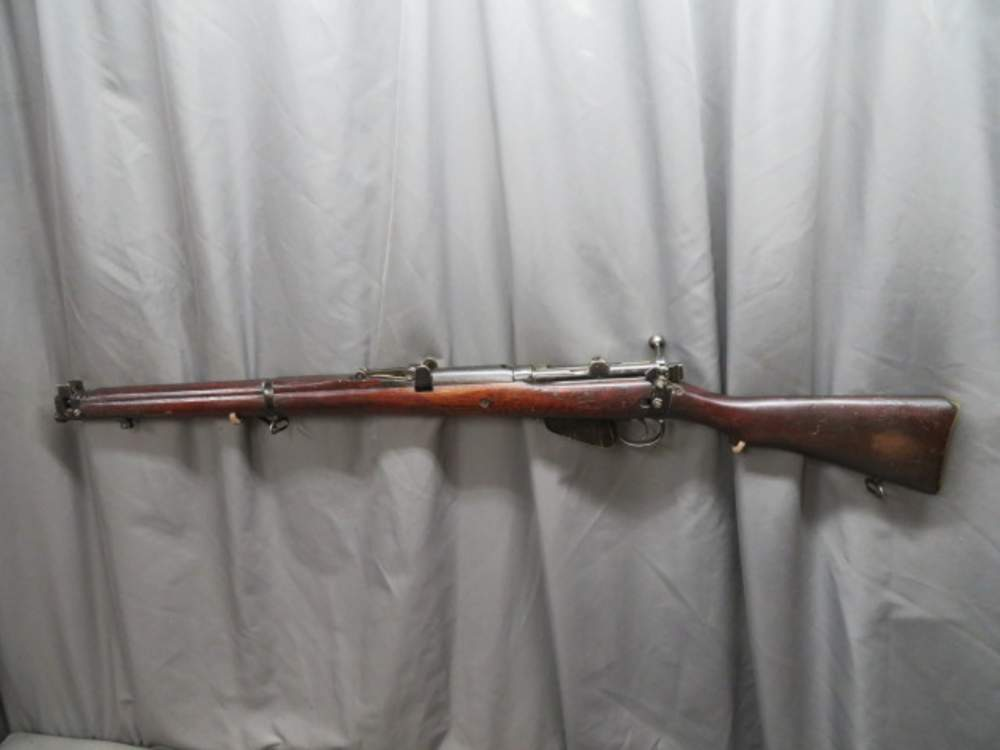
The Lee-Enfield entered British service in 1895 as a bolt-action repeater chambered in .303 British, known for a fast, smooth bolt throw that let trained soldiers fire faster than most other bolt-actions of the era. It remained in first-line and reserve service through both World Wars and well beyond, produced and re-produced across the British Empire for over half a century.
The broad arrow
Look for a small arrow-shaped mark, sometimes called a “pheon.” This is the classic British government property mark, stamped on countless pieces of British military equipment for centuries, not just rifles. Finding one on a Lee-Enfield confirms it was genuine issued British (or Commonwealth) ordnance property at some point in its life.
Manufacturer & factory codes
The maker’s mark is stamped on the knox-form — the flat area of the receiver near the chamber — alongside a year of manufacture. Because Lee-Enfields were built across the British Empire, the code tells you not just who made it, but often where:
| Code / Name | Maker | Where |
|---|---|---|
| RSAF Enfield | Royal Small Arms Factory | England (the original maker, hence the rifle’s name) |
| BSA Co. / “B” / M47C | Birmingham Small Arms | England (Shirley plant, No. 4 production) |
| ROF Fazakerley, ROF Maltby | Royal Ordnance Factories | England (No. 4 production) |
| Lithgow | Lithgow Small Arms Factory | Australia |
| Ishapore / RFI | Rifle Factory, Ishapore | India (“RFI” specifically marks post-1947 production) |
| Long Branch | Small Arms Ltd. | Canada (No. 4 production) |
| Savage | Savage Arms | USA (No. 4 production, Lend-Lease) |
On British No. 4 rifles, the serial number itself can also hint at the factory: batches allotted in the 1XXXX range commonly trace to Maltby, 2XXXX to Fazakerley, and 3XXXX to BSA Shirley — a useful cross-check against the stamped code, though treat it as a pattern to confirm, not an absolute rule.
Telling No. 1 and No. 4 apart
Alongside the maker code you’ll find the model designation stamped as well — “No. 1 Mk III,” “No. 4 Mk I,” and so on. If the stamp is worn, the fastest visual tell is the muzzle: the No. 4 has a heavier barrel that protrudes slightly past the nose cap, while the No. 1 Mk III has a blunt nose with the barrel enclosed by the wood.
US import marks
If a Lee-Enfield came into the US as commercial surplus, federal law (the Gun Control Act of 1968, with additional requirements added in the 1980s) requires an importer’s mark showing the country of origin and importer — a stamp added at the time of import, not during original military production. Any rifle carrying one of these marks definitely crossed into the US after that importer was active, which is a genuinely useful dating clue on its own. Century Arms and its predecessor FIE are two of the more commonly seen importer names on surplus Lee-Enfields in the US market.
Cousins: the No. 5 “Jungle Carbine”
The No. 5 Mk I, nicknamed the “Jungle Carbine,” is a shortened, lightened late-war derivative of the No. 4 built for jungle warfare in the Pacific and Southeast Asia theaters — recognizable by its shorter barrel, flash hider, and distinctive lightening cuts on the receiver. It’s a genuinely different collecting category from the full-length No. 1 and No. 4 rifles, not simply a shorter version of the same gun.
Sources
- Enfield Rifles Identification & Dating — Relics & Rifles
- The Lee Enfield Rifle — Milsurps Collectors Forums
- Rifle Factory Ishapore
- Jungle Carbine Import/Export Marks — Milsurps Collectors Forums
Collector reference and forum sources, cross-checked across multiple threads. Serial-range-to-factory patterns are commonly cited estimates, not a guarantee for every individual rifle.
Want the fuller story behind the Lee-Enfield’s design and service history? Read our Lee-Enfield history piece, or browse current inventory.
Markings That Matter for Authentication
Beyond the maker codes and markings covered above, several other markings and features are important to check closely when you’re evaluating a Lee-Enfield’s originality:
- Matching bolt and receiver: Check that the serial number on the bolt matches the serial number on the receiver. A matching bolt supports the rifle’s originality, while mismatched components often indicate a rifle that was assembled from mixed parts.
- FTR stamps (Factory Thorough Repair): An FTR stamp shows the rifle went through a Factory Thorough Repair program and is no longer in its original wartime configuration. FTR rifles are common among examples imported into the U.S., and FTR work often explains parts with mixed serial numbers.
- Maker or factory: Lee-Enfields were produced at several factories, including BSA Shirley, Maltby, Fazakerley, Long Branch, Lithgow, and Ishapore. Identifying the maker is a first step in confirming that a rifle’s markings and features are consistent with its origin.
- No.4 Mk 2 hung trigger: The No.4 Mk 2 is identified by its hung trigger, which sets it apart from earlier No.4 variants.
- US PROPERTY, Savage, and Stevens Lend-Lease marks: US PROPERTY markings, along with Savage or Stevens maker marks, identify rifles produced in the United States under the Lend-Lease program.
- No.4 Mk I(T) sniper markings and scope serials: A T marking, along with related TR marks, identifies a No.4 Mk I(T) sniper rifle. Check whether the scope’s serial number matches the rifle, since a mismatched scope is a break from the rifle’s original sniper configuration.
- Ishapore 2A and 2A1: The Ishapore 2A and 2A1 are chambered in 7.62 NATO rather than .303, which distinguishes them from the .303 No.1 rifles.
Free for collectors: Is your K98k original? Get the 5-point check.
One page, about ten minutes, with the receiver ring codes, Waffenamt stamps, matching numbers, and the signs of a rebuild. Sent to your email in seconds.