A plain walk-through for the Imperial Japanese Type 38 rifle. How to read the chrysanthemum, type characters, series kana, serial, and arsenal mark — and how to keep Type 99 caliber confusion, restored mums, and lookalike cousins from wrecking your read.
Long-rifle focus here. Carbine gets a light note. Deep Chinese / Thai / Siamese variants wait for a later guide.
Worked examples on site:
- Tokyo Arsenal, full mum, US bringback papers — pre-series, assembly-number matching
- Jinsen 30th series, matching w/ mum — series-era overseas arsenal
Quick identification checklist
Work the rifle top to bottom. Write what you see before you decide what it “should” be.
- Top of receiver — 16-petal chrysanthemum (mum) intact, ground, school-marked, “M”, or concentric circles? Type characters for 38 (use a photo — don’t invent calligraphy).
- Left rail — circled series kana present or absent? Full serial (including leading zeros if any). Arsenal symbol after the serial.
- Caliber / type family — Type 38 = 6.5×50mmSR. Type 99 = 7.7×58mm. Never assume from “Arisaka” alone.
- Matching system — early Tokyo often uses an assembly number under the receiver; series-era rifles more often carry serial digits on small parts. Say which system you checked.
- Import / bringback path — importer stamp on barrel/receiver? Papers? Mum status alone does not prove the path.
- Configuration — long rifle vs carbine length; dust cover / cleaning rod present or missing; school or reserves marks.
- Cousins — Mexican 1913 crest rifle (7×57), Chinese conversions, Type 35 / 44 / 97 / 99 family. Related, not the same ID pack.
Then dig into the sections below.
What you’re looking at
Type 38 = bolt-action Imperial Japanese service rifle adopted 1905, chambered 6.5×50mmSR Arisaka. Long rifle, short rifle, and carbine configurations exist. It stayed common through WWII even after the Type 99 (7.7) arrived.
Collectors confuse Type 38s with Type 99s, Mexican contract crest rifles, and Chinese-converted barrels. Start with marks and caliber — not the stock length alone.
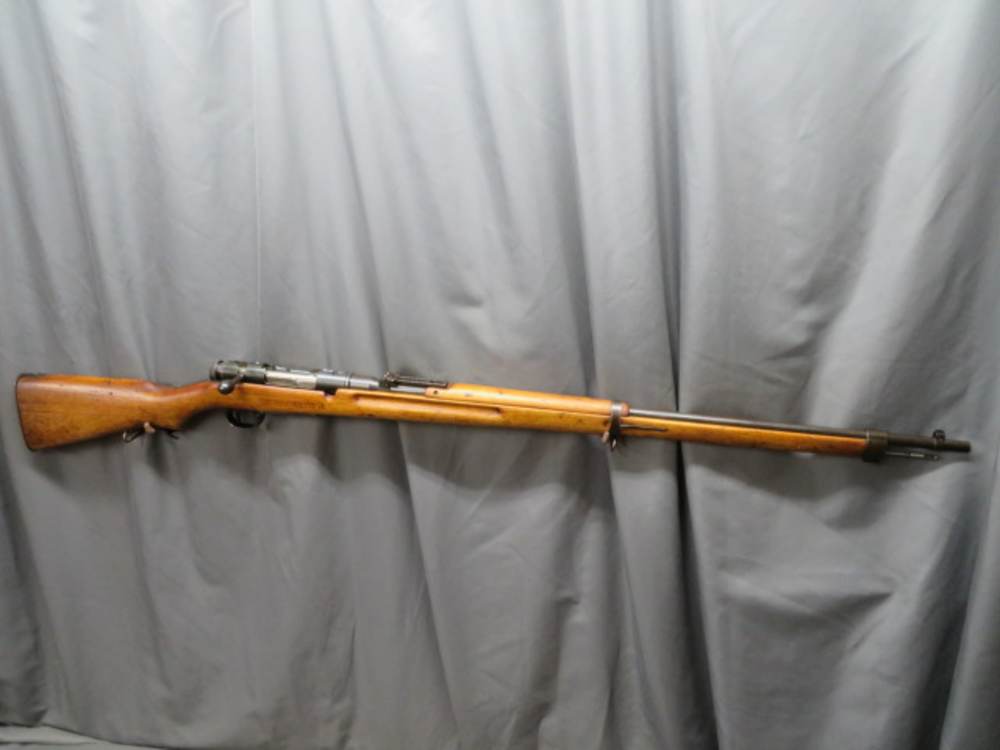
How to read the receiver
Teaching order:
- Top of receiver: Imperial chrysanthemum + type characters (三八式 / “38 Type” pattern — use a plate or photo; don’t invent stroke-by-stroke calligraphy in copy).
- Left side of receiver: optional series kana in a circle, then serial number, then arsenal symbol. Commercial subcontractors show up more often on Type 99 volume than on Type 38 long-rifle volume — don’t invent Type 38 subcontractor series without a book plate.
Chrysanthemum and other crest outcomes
Mum = Imperial ownership seal on official Imperial-issue rifles.
| What you see | Collector read (qualified) |
|---|---|
| Intact mum | Often associated with field-capture / early bringback narratives. One clue among many — not sole provenance proof. |
| Ground / struck / cancelled mum | Commonly associated with surrender / occupation-era processing. Again: one clue. Combine with papers, configuration, and matching. |
| School / training character between mum and type characters | Often with leading zeros in the serial. Status change, not a separate maker. Don’t date from zeros alone. |
| Elongated “M” | Military reserves mark on some transferred rifles (also taught on Type 35 cousins). |
| Mum overstamped with stacked cannonballs or a ring of small circles | Removed from Imperial service / transferred — see plates. |
| Two concentric circles instead of mum | Small numbers of Type 38 (and Type 99) rifles. Purpose uncertain in the literature (paramilitary / special-issue speculation). Some look factory-marked; some look mum-removed then remarked; often serialized separately. |
Mum grinding causation: Collector literature and oral history conflict on whether grinding was a Japanese order, a US occupation instruction, informal practice, or some mix. No single primary document for a universal “grind all mums” order is treated as settled here. Qualify causation — don’t publish a universal MacArthur-order claim.
Arsenals, series, and dating
Type 38s are not dated with a German-style year stamp on the receiver. Approximate date comes from arsenal + (series if present) + serial, compared to published production projections (Allan & Macy) or estimated serial tables (McCollum / Honeycutt via Old Military Markings). Those projections are estimates, not factory day-stamps.
Field dating checklist
- Identify the arsenal symbol (use a photo/plate — don’t invent drawings from memory).
- Note presence or absence of circled series kana.
- Record the full serial, including leading zeros if any.
- Compare to Allan projection tables or the McCollum–Honeycutt estimate table.
- Confirm configuration features match the era (finish, numbered-parts practice — see Matching).
Pre-series Tokyo / Koishikawa
Early Type 38 long rifles numbered consecutively within type. Collector tables put Koishikawa (Tokyo), series none, serials roughly 0–~2,029,000, dates roughly 1906–ca.1935. Secondary summaries of Tokyo Arsenal production often land around 1906–1932, ~2,029,000 estimated. The Armory’s documented Tokyo example — no series, full mum — is a classic pre-series teaching piece.
→ Tokyo full-mum bringback history
Series system (~1933+)
Serials reset in blocks of about 100,000 (0–99,999 per Honeycutt note in the McCollum transcription), identified by a small kana character inside a circle left of the serial. Same numeric serial can exist under different series — always read series + serial + arsenal together.
Do not invent kana glyphs in text. Use a photo or identification plate.
High-level Type 38 long-rifle ranges from Old Military Markings (McCollum/Honeycutt-based; estimates only):
| Arsenal | Series | Serial range (table) | Dates (table) |
|---|---|---|---|
| Kokura | 20 | 29,000–49,000 | 1933–1940 (row date span) |
| Kokura | 22–25 | 0–99,999 each | (same row family) |
| Kokura | 26 | 0–~71,000 | |
| Nagoya | none | 2,021,000–2,031,000 | 1923–ca.1933 |
| Nagoya | 26–28 | 0–99,999 | ca.1933–ca.1940 |
| Nagoya | 29 | 0–~8,000 | |
| Jinsen | none | 0–~1,400 | ca.1939–ca.1940 |
| Jinsen | 30 | 1,000–13,000 | |
| Mukden | none | 0–30,000; also 5,000,000–5,065,000; also 65,000–79,000 | ca.1934–ca.1940 |
Mukden caution: Some Mukden serials are preceded by hiragana that collectors have misread as “300,000-range” Western digits. Read the plate note before expanding digits.
Jinsen date variance: Estimate tables and secondary summaries disagree on exact year spans for Jinsen Type 38 production. Treat Jinsen dates as estimate conflict — name the arsenal and series; don’t lock a single year in first public copy without a book page check.
→ Jinsen 30th series — Matching w/ Mum
Arsenals collectors see on Type 38s
| Arsenal (English) | Role / notes |
|---|---|
| Koishikawa / Tokyo | Primary early producer; stacked-cannonballs family shared with later Kokura in collector recognition — early Tokyo vs later Kokura distinguished by era, series presence, and features. Verify symbol from a plate. |
| Kokura | Series-era Type 38 production. |
| Nagoya | Early non-series continuation + series blocks. |
| Jinsen (Korea; modern Incheon) | Smaller Type 38 run including 30th series examples. |
| Mukden / Hoten (Manchuria; modern Shenyang) | Distinct serial patterns including non-series and special ranges. |
Subcontractors common on Type 99 tables (Toyo Kogyo, Tokyo Juki Kogyo, Howa, Izawa, and similar) are primarily Type 99 volume makers — don’t invent Type 38 subcontract series without Allan / Honeycutt confirmation.
Matching by era
Unlike a single German “last three digits everywhere” habit, Type 38 matching practice changed by arsenal and period. Saying “all matching” without saying which numbering system mis-educates.
Detail below leans on collector discussion that paraphrases Allan (The Type 38 Arisaka). Treat the digit schemes as qualified secondary, not as invented hard rules.
Early Tokyo / Koishikawa (pre-series)
Parts commonly matched to an assembly number stamped under the receiver (near the front trigger-guard screw lug area), not necessarily to the long side-rail serial. Collectors often check assembly numbers on bolt-related parts and the stock channel. Fully matching early Tokyo rifles are uncommon after long service.
Armory Tokyo teaching example: matching assembly numbers except floorplate, extractor, safety, and firing pin.
Kokura series-era (commonly discussed 20th–26th)
Matching often described as small parts carrying last digits of the rifle serial (series-era shorter serials). Qualify — page-level Allan detail varies by series.
Nagoya series-era
Often described as assembly number on receiver and barrel, with many small parts matching last three of serial — with simplification later in some series. Carbine-specific Allan notes exist; don’t blanket-apply carbine rules to every Nagoya long rifle.
What collectors typically check
- Receiver side-rail serial (+ series + arsenal)
- Underside / hidden assembly number (especially early Tokyo)
- Bolt body / components (extractor, safety, firing pin often separately numbered or unnumbered by era)
- Floorplate / trigger guard / magazine box
- Bands, cleaning rod (when numbered)
- Stock / handguard numbers or inspector stamps (buttstock underside kanji proofs show up on Armory examples)
Late or arsenal-repaired rifles may have legitimate mismatches. A mismatched bolt alone is extremely common on US-circulating guns.
Imports, bringbacks, and conversions
US GI bringbacks
Large numbers of Arisakas entered the US as WWII / occupation souvenirs. Many are not import-marked (pre-1986 / personal bringback pathways). Genuine bringback papers (customs / theater authorization) are historically meaningful when real.
Armory Tokyo example: documented papers for a Technician 5th Grade with the 17th Field Hospital — full personal identifiers redacted in public education copy; papers framing stays.
→ Full chrysanthemum bringback history
Import marks
Post-1968/1986 commercial imports may show importer stamps on barrel or receiver. Presence identifies commercial import path, not Japanese factory origin. Absence ≠ automatic battlefield capture.
Mum status vs path
Intact mum ≠ proof of combat pickup. Ground mum ≠ “bad” or “import only.” Combine with papers, configuration, and matching.
Chinese capture & conversion (short)
Some Chinese-captured Type 38s were rebarreled / rechambered — secondary literature cites 7.92×57mm Mauser examples and postwar 7.62×39mm conversions on some carbines. Chinese “six/five” and other locally marked cousins exist. Short callout only here — deep Chinese marking language waits for a later guide.
British WWI use
Real foreign use exists in the literature (Pattern 1907 / RN-related Type 38 purchases). Verified UK-used serial ranges belong in Allan — don’t invent ranges in this first pass.
Fakes, restored mums, and lookalikes
Mum “restoration” / restamp
Ground receivers sometimes receive modern mum stamps to inflate desirability. Tells collectors discuss: finish disturbance only around the crest, grind topography under a “too crisp” flower, wrong border/depth vs roll-stamped wartime mums, laser-engraved look. Prefer an honest ground mum + matching originality over a pretty restamped crest.
Force-matching
Bolts swapped for decades; restamped bolts to “match” exist. Compare fonts, depth, wear, and whether the rifle’s era used assembly numbers vs serial digits.
Type 99 vs Type 38 caliber confusion (high priority)
| Type 38 | Type 99 | |
|---|---|---|
| Cartridge | 6.5×50mmSR | 7.7×58mm |
| Type characters | 38 pattern | 99 pattern |
| Common US profile | Longer rifle common | Short rifle common |
| Early extras | — | AA rear-sight wings / monopod on some early examples |
Never assume caliber from “Arisaka” alone — read the type marking and measure / headspace before firing.
Mexican Model 1913 (cousin, not a fake)
Koishikawa-built Type 38–pattern rifles for Mexico with REPUBLICA MEXICANA eagle crest + 1913 on the receiver — no Japanese mum / type / arsenal layout like a service Type 38. Chambered 7×57 Mauser, not 6.5. Scarce; many survivors altered. Contract delivery totals disagree across secondaries — hold totals in public copy until a book page settles them.
Sporterizing
Cut stocks, drilled scopes, missing dust covers / rods — common on US guns. Configuration loss, not “repro rifles.” School rifles often later sporterized.
Reproduction accessories
Monopods, dust covers, cleaning rods, AA wings are commonly reproduced. Treat accessory originality claims carefully (same caution collectors use on Type 99 accessory sets).
Cousin callouts (short)
Related rifles that get misidentified as a service Type 38 long rifle. Short notes only.
Carbine / short rifle
Type 38 carbines and short rifles exist — shorter barrel / different furniture. Same mum / type / series / arsenal reading order. Matching and configuration details differ; don’t force long-rifle expectations onto a carbine.
Type 35 Navy / “M” reserves
Earlier naval Type 35. Armory example teaches mum removed and replaced with an “M” military-reserves mark + Tokyo side-rail mark. Cousin for reserves-cancellation language — not a Type 38.
Type 44 carbine
Related Type 38-action carbine with folding bayonet family story. Separate ID pack if you go deep.
Type 97 sniper
Type 38-based sniper cousin — scope / mount story, not this guide.
Type 99 / Type 2 family
Type 99 = 7.7 family. Type 2 paratrooper = takedown 7.7 cousin with its own mum / type-2 markings. Cross-link only.
Mexican 1913
See Fakes / lookalikes above — crest rifle in 7×57.
Later guides
Standard Type 38 long-rifle identification only here. Deep Chinese conversions, Thai / Siamese contract cousins (Type 66 / Type 83 family), and full Type 44 / Type 97 chapters belong in later guides.
Sources
- Allan, Francis C. & Macy, Harold W. The Type 38 Arisaka: A Study of the Japanese Rifles and Carbines Based Upon the Type 38 Arisaka Action, Their Variations and History. AK Enterprises, 2007; Revised Edition 2021.
- Honeycutt, Fred L., Jr. & Anthony, F. Patt. Military Rifles of Japan. 5th ed. Julin Books, 1996.
- McCollum, Duncan O. Japanese Rifles of World War II. Excalibur Publications, 1996.
- Old Military Markings. Markings on Japanese Arisaka Rifles and Bayonets of World War II (McCollum + Honeycutt adaptation).
- Castle-Thunder.com. Japanese Arisaka Rifle Identification.
- Relics & Rifles. Arisaka Type 99 Identification & Dating (crest / reading-order teaching; concentric-circle note).
- Wikipedia. Type 38 rifle (orientation).
- HandWiki. Engineering:Arisaka (mum-defacement historiography summary — secondary).
- Eisel Armory Weapon History:
Markings That Matter for Authentication
Beyond the basic receiver markings, a handful of other markings and features should be checked closely when you’re evaluating a Type 38’s originality:
- Intact Imperial chrysanthemum: An intact Imperial chrysanthemum (the “full mum”) on the receiver means the Imperial crest was never defaced. A full, undamaged mum shows the rifle kept its original crest marking.
- Scrubbed or ground chrysanthemum: A chrysanthemum that has been ground off, scrubbed, or defaced reflects surrender or depot-era practice rather than later tampering. Look for grinding marks or partial petals where the crest was removed.
- Sold-out-of-service arsenal strike into the mum: Some rifles carry an arsenal symbol, such as the Kokura mark, struck into the chrysanthemum. This marking identifies a rifle officially released from military service and is distinct from a scrubbed mum.
- Matching bolt, safety, and dust cover: Check that the bolt, safety, and dust cover carry numbers matching the rifle. Matching numbers on these components support their originality to the rifle.
- Arsenal marks: Arsenal marks identify the facility that produced the rifle, such as Kokura, Nagoya, or Tokyo (Koishikawa). Along with the series designation, they place the rifle within its production history.
- Dust cover and cleaning rod: As issued, the Type 38 had a sliding dust cover over the action and a cleaning rod under the barrel. Check that both are present, since either one is commonly missing from surviving rifles.
- Sporterized or cut stock: A cut-down or reshaped stock marks a rifle that has been sporterized and is no longer in its original military configuration. Look for a shortened forend, removed handguard, or altered hardware as signs of civilian modification.
Further reading (optional shelf)
Classic collector books. They were not page-checked line-by-line for this draft and are not required gates before publish — useful shelf when you want deeper plates and series tables.
- Allan, Francis C. & Macy, Harold W. The Type 38 Arisaka (2007; Rev. 2021) — definitive specialized secondary; keep on desk for series/matching depth.
- Honeycutt, Fred L., Jr. & Anthony, F. Patt. Military Rifles of Japan (5th ed., 1996) — plates and arsenal/series orientation.
- Harriman, Bill. The Arisaka Rifle. Osprey Weapon 70, 2019 — accessible overview.
- White, Doss & Voigt, Don. The Japanese Type 99 Arisaka Rifle — for later T99 cousin chapters.
- Allan, Francis C.; White, Doss H.; Zielinski, Stanley. The Early Arisakas — for Type 30/35 cousin depth.
Free for collectors: Is your K98k original? Get the 5-point check.
One page, about ten minutes, with the receiver ring codes, Waffenamt stamps, matching numbers, and the signs of a rebuild. Sent to your email in seconds.