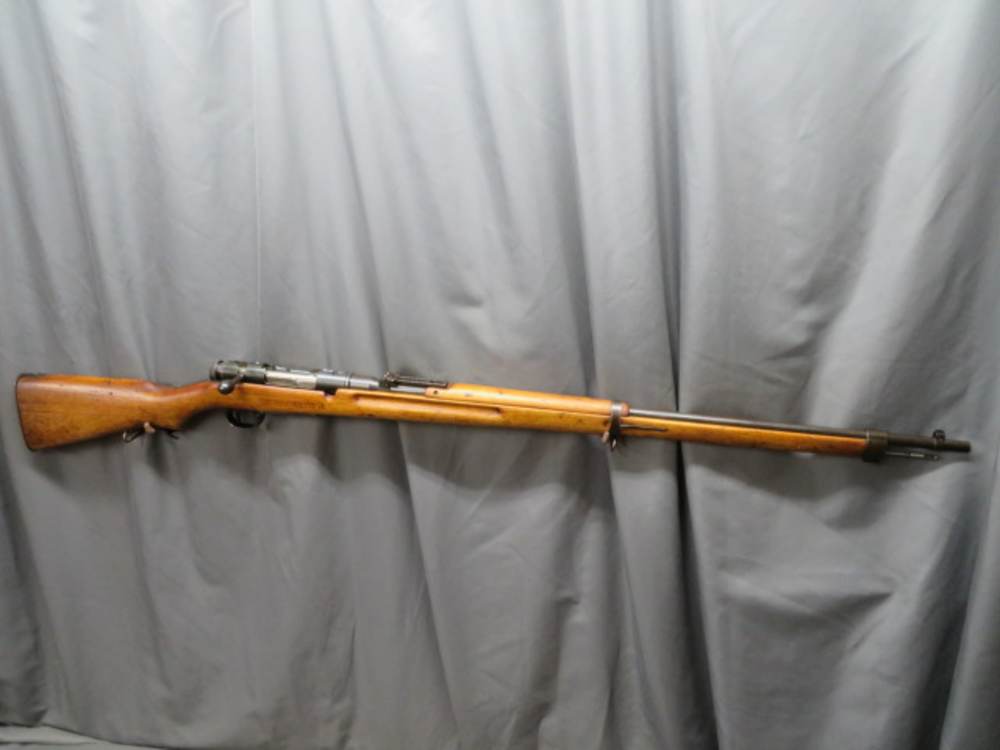
Adopted in 1905, the Japanese Type 38 was a bolt-action service rifle chambered in 6.5×50mmSR Arisaka. It remained widely used through World War II, even after Japan introduced the 7.7mm Type 99. For collectors, its receiver markings, arsenal symbol, numbering system, and chrysanthemum crest can reveal much about a rifle—but none proves its complete history on its own.
This page is the family story. For a hands-on walk-through of markings, see the Arisaka Type 38 Identification & Collector’s Guide.
What it is
The Type 38 came as a long rifle, a shorter rifle, and carbine-length guns. The long rifle is what most US collectors see first: a full-length barrel and ladder-style rear sight. Shorter packages are related; the Type 44 carbine is a cousin with its own story, covered in the Identification Guide rather than here.
Do not assume caliber from the word “Arisaka” alone. Type 38 rifles are 6.5mm. Type 99 rifles are 7.7mm. Read the type characters on the receiver before you treat any Arisaka as one or the other.
Who used them
Imperial Japan was the main user—the Type 38 was the Army’s standard service rifle for decades and stayed common beside the Type 99 in WWII. It was not Japan-only.
Chinese forces fielded large numbers through purchase, transfer, and capture (into the Civil War years). Some secondary sources also describe postwar Korean Constabulary / early ROK stocks that included Type 38s—treat that trail carefully until a given rifle’s marks support it. Collector literature notes that some Chinese-held guns were later rebarreled or rechambered (including 7.92×57 work and, on some carbines, 7.62×39 conversions); confirm caliber on the gun, don’t assume from a story.
In World War I, Britain also bought Type 38–pattern rifles for training and secondary use; some of those guns later moved through other Entente hands, including Russia. Separate from Japanese-service rifles are contract and cousin patterns such as the Mexican Model 1913 (Tokyo-built in 7×57 with Mexican crests, not a Japanese mum layout) and Siamese/Thai families. Most US collector examples are WWII / occupation bringbacks rather than those earlier foreign contracts.
Who built them
Early production is tied to Tokyo Arsenal (Koishikawa)—often just called Tokyo—the Imperial Japanese Army’s primary home for the design after adoption. Later Japanese work also came from Kokura and Nagoya. Overseas Imperial arsenals at Jinsen (Korea; modern Incheon) and Mukden / Hoten (Manchuria; modern Shenyang) added further Type 38 output. On a rifle in hand, the arsenal symbol beside the serial—not the word “Arisaka” alone—is what names the maker. Commercial subcontractors show up more often on Type 99 production than on the classic Type 38 long-rifle story.
Why the chrysanthemum matters
The 16-petal Imperial chrysanthemum (“mum”) on top of the receiver is the Imperial ownership seal on official issue rifles. Collectors see several outcomes:
- Intact mum — often discussed with field-capture or early bringback stories. One clue among many; it does not prove a complete provenance by itself.
- Ground or cancelled mum — often linked with surrender or occupation-era processing. Exactly who ordered widespread grinding is still debated in the literature—treat causation carefully.
- School marks, “M” reserves marks, or concentric circles — signs the rifle changed status (training, reserves, or a special marking pattern). Details live in the Identification Guide.
Full mum markings are fine to show on education photos. An honest ground mum with original matching often beats a pretty restamped crest.
Arsenals, series, and dating
Pre-series Tokyo / Koishikawa rifles carry a long consecutive serial and arsenal symbol with no circled kana beside the number. Published tables put that run in the early decades of Type 38 production—those dates are estimates, not a year stamp on the receiver.
Collector references often place a series system starting around the early 1930s (commonly cited near 1933): many arsenals reset serials in blocks marked by a small kana character in a circle left of the serial. Exact start years can vary by arsenal and source—use the marks on the gun plus a published table, not a single round year as gospel. The same numeric serial can exist under different series letters, so always read series + serial + arsenal together.
Dating a Type 38 is arsenal + (series if present) + serial compared to published estimates—not a German-style two-digit year on the receiver ring. For symbol charts and series reading, use a photo plate or the Identification Guide rather than guessing from text alone.
On-site series example: Jinsen 30th series — Matching w/ Mum. Full markings walk-through: Arisaka Type 38 Identification & Collector’s Guide.
Matching — it depends on the era
Type 38 matching is not one German-style “last three digits on every part” habit.
- Early Tokyo: parts often match an assembly number under the receiver, not the long side-rail serial. Fully matching early Tokyo rifles after long service are uncommon.
- Later series-era guns (Kokura, Nagoya, and similar): small parts more often carry the last digits of the rifle serial, with arsenal quirks by period.
Bolt swaps are extremely common on guns that circulated in the US. “All matching” only means something when you name which numbering system that arsenal and era used. More detail: Matching by era.
How they reached US collectors
Huge numbers came home as WWII and occupation souvenirs. Many are not import-marked. Bringback or capture papers (when genuine) document a personal path; commercial importer stamps document a later commercial path. They are not the same thing. Mum status alone does not prove either story.
Chinese capture, conversion notes, and Siamese/Thai cousins stay short here—see the Identification Guide.
Related rifles
Short pointers only; full depth stays on the Identification Guide (and separate history posts where linked).
- Type 99 — 7.7mm cousin; different type characters (don’t confuse caliber). See the Identification Guide.
- Mexican Model 1913 — Type 38–pattern contract in 7×57 with Mexican crests (see Guide).
- Type 35 Navy / “M” reserves — earlier naval cousin.
- Type 44 carbine / Type 97 sniper / Type 2 paratrooper — related families.
More reading
- Arisaka Type 38 Identification & Collector’s Guide
- Jinsen 30th series — Matching w/ Mum
- Weapon History
Free for collectors: Is your K98k original? Get the 5-point check.
One page, about ten minutes, with the receiver ring codes, Waffenamt stamps, matching numbers, and the signs of a rebuild. Sent to your email in seconds.