From Baby Dragoon to New Pocket Model
A compact personal-defense arm with a history spanning workshops, wartime purchases and diplomatic gifts
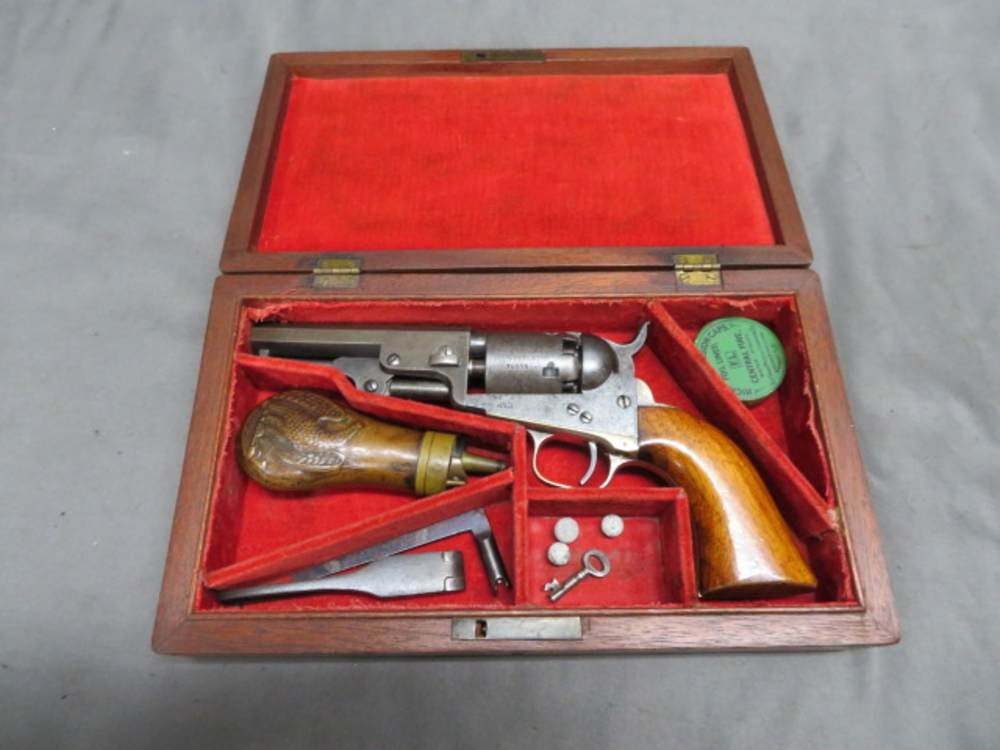
The Colt Model 1849 Pocket Revolver belonged to a family of compact arms intended for personal defense. Museums Victoria calls it the New Pocket Model and describes it as an improved continuation of the 1848 Baby Dragoon. Changes included an attached loading lever, rectangular cylinder stops with guides, and a stagecoach hold-up scene replacing the earlier military scene. These details help explain its development and distinguish the related families more reliably than size alone.
Hartford Manufacture and London Production
Colt's Patent Fire Arms Manufacturing Company built the family at Hartford, Connecticut. NRA Museums also records London production during the mid-1850s. Museum accounts differ on the beginning and ending dates, with some potentially including different family boundaries. Developed from Colt's late-1840s pocket revolvers, the family remained in manufacture into the early 1870s. The Metropolitan Museum reports more than 300,000 produced, but the available accounts do not establish an exact total or a shared accounting boundary. Its American history begins with domestic manufacture.
Cylinders, Barrels and Catalogue Differences
The documented standard family was .31 caliber, with both five- and six-shot cylinders represented in museum collections. Museums Victoria describes a six-chamber example with a rifled octagonal barrel and loading lever. The Met lists four-, five- and six-inch barrel options, without establishing an exhaustive catalogue. Its account credits Waterman Lilly Ormsby with the cylinder ornament and connects the armed stagecoach-defense scene to the pistol's protective purpose. Catalogue discrepancies remain: The Met lists one presentation example as .32 caliber, while Charleston Museum lists an identified Model 1849 as .36. Those entries do not establish standard variants in either caliber.
Private Wartime Use and Overseas Circulation
NRA Museums states that Civil War soldiers acquired Model 1849 revolvers for personal protection and documents a Union enlistee's purchase in 1864. That supports private wartime use, rather than general government issue. Overseas connections require similar care. Museums Victoria records a Hartford-made example with British proofmarks indicating the British market and a Melbourne retailer's workshop marking, documenting commercial circulation involving Britain and Australia. The Met records Colt's presentation of a Model 1849 to Russia's Czar Nicholas I in 1854. Neither commercial circulation nor a diplomatic gift establishes national military adoption.
Related Colts with Different Features
The Baby Dragoon is the directly documented predecessor, making its loading arrangement, cylinder stops and cylinder scene useful comparison points. Two other Colt models offer distinct contrasts. NRA Museums describes the Model 1862 Police as a separate five-shot, .36-caliber percussion revolver whose rebated, half-fluted cylinder accommodated a larger caliber on a small frame. The Model 1855 Root instead used a side-mounted hammer, a spur trigger and a fully enclosed cylinder. Those structural differences give a first-time observer firmer distinctions than a general resemblance between compact revolvers.
Why the Family Matters to Collectors
The Model 1849 brings together personal defense, private wartime purchases and changing cylinder capacity. Special examples add other historical themes: The Met describes gold inlay and relief carving in Colt's presentation group, while the Autry preserves a cutaway demonstration example exposing the mechanism for instruction and promotion. These features belong to documented special examples and should not be assumed for an ordinary revolver. For collectors, the family's significance lies in connecting mechanical variation with the ways Colt arms were carried, demonstrated and presented.