火药 · HUOYAO · FIRE MEDICINE
The History of Gunpowder
An accidental elixir that remade war, trade, and empire — from Tang dynasty alchemy to the last clouds of black powder.
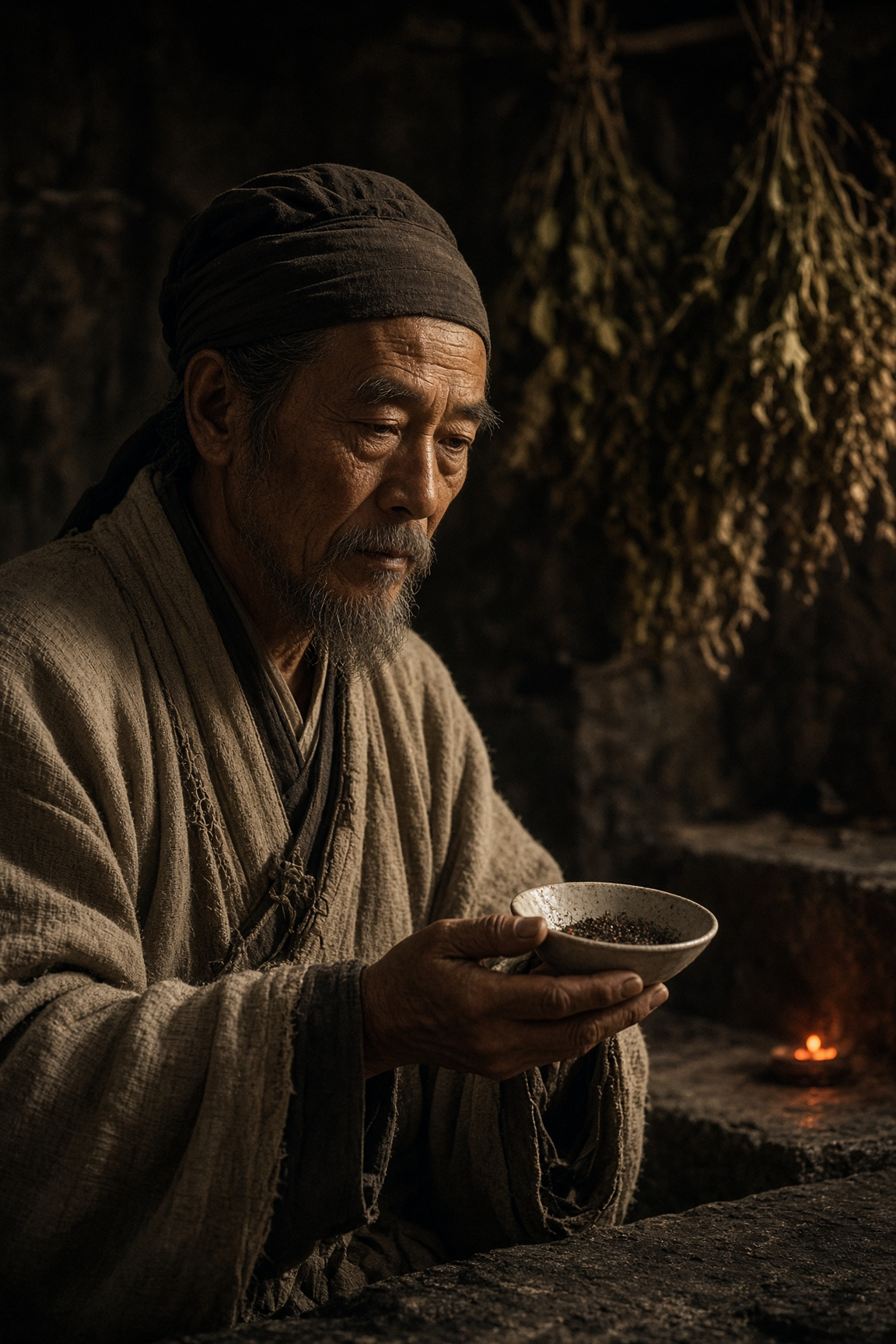
The seeker of elixirs. Gunpowder was not designed. It was discovered by people looking for something else.
They were looking for life without end.
Chinese alchemists of the Tang dynasty heated minerals in search of an elixir. What they found, sometime in the ninth century, was huoyao — fire medicine. A Daoist text of the period is blunt about the result: mix the wrong things, apply heat, and you may burn your hands, your face, and the house around you.
“Smoke and flames result, so that their hands and faces have been burnt, and even the whole house where they were working burned down.”
Zhenyuan miaodao yaolüe, c. 850
Seven dates that matter
-
c. 850
Tang China
Alchemists record a dangerous mixture
-
1044
Northern Song
Wujing Zongyao writes the formulas down
-
1132
De’an
Fire lances at a city wall
-
c. 1267
Eurasia
Bacon, al-Rammah, the formula goes west
-
1346
Crécy
Early cannon on a European field
-
1453
Constantinople
Bombards against the Theodosian walls
-
1884
France
Vieille’s Poudre B ends the smoke age
850
Tang dynasty
Origins in the furnace
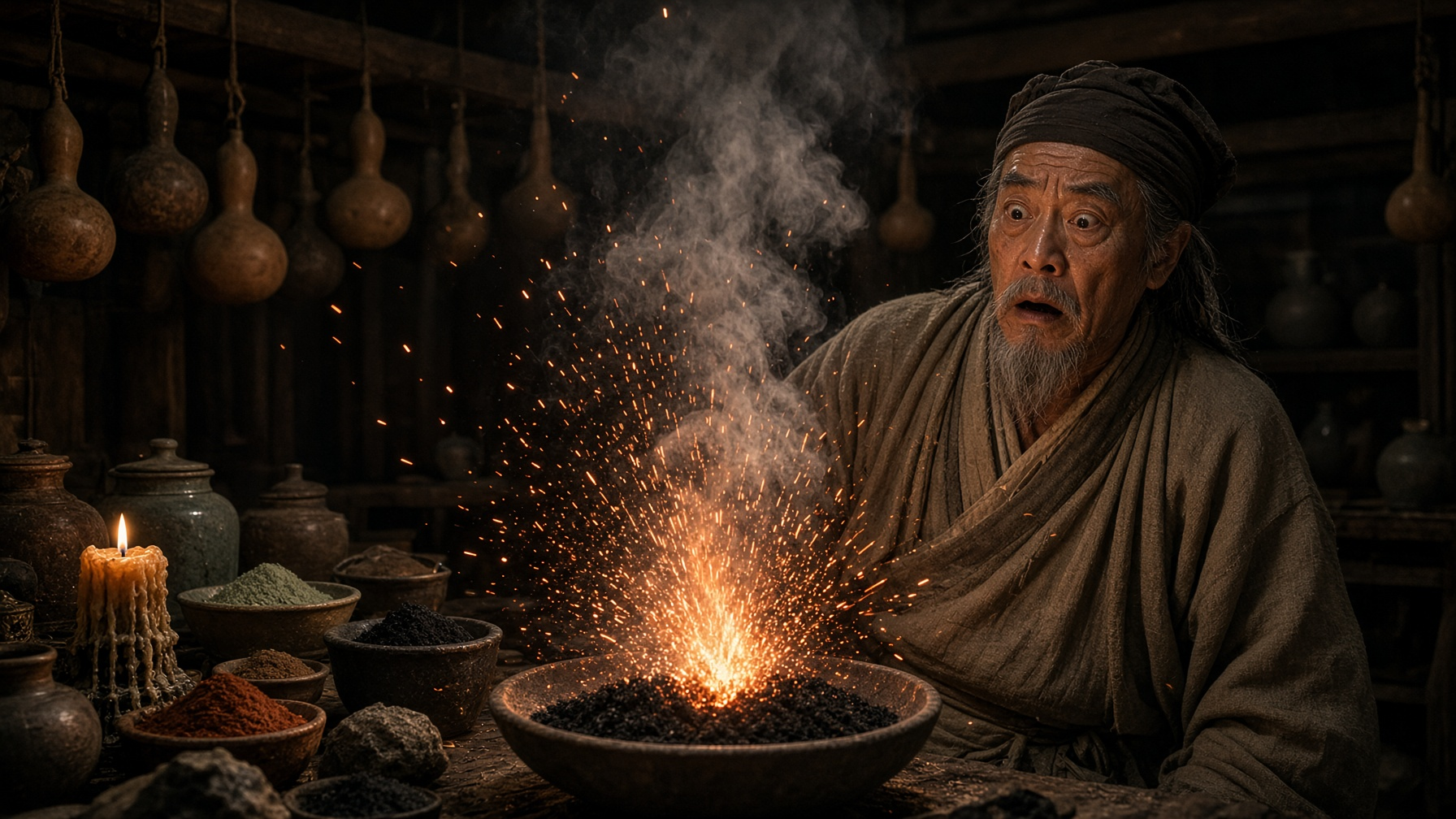
A Tang workshop, the night immortality caught fire.
Gunpowder is one of China’s four great inventions, but it was not invented on purpose. The earliest identifiable references sit in Daoist alchemical writing of the ninth century. The goal was transmutation and long life. The by-product was a deflagrating powder.
The Chinese name, 火药 (huoyao), still means “fire medicine.” Before it was a weapon, it was a drug that failed — spectacularly. Military use followed within a century.
Song China · 1044–1279
From fire medicine to fire lance
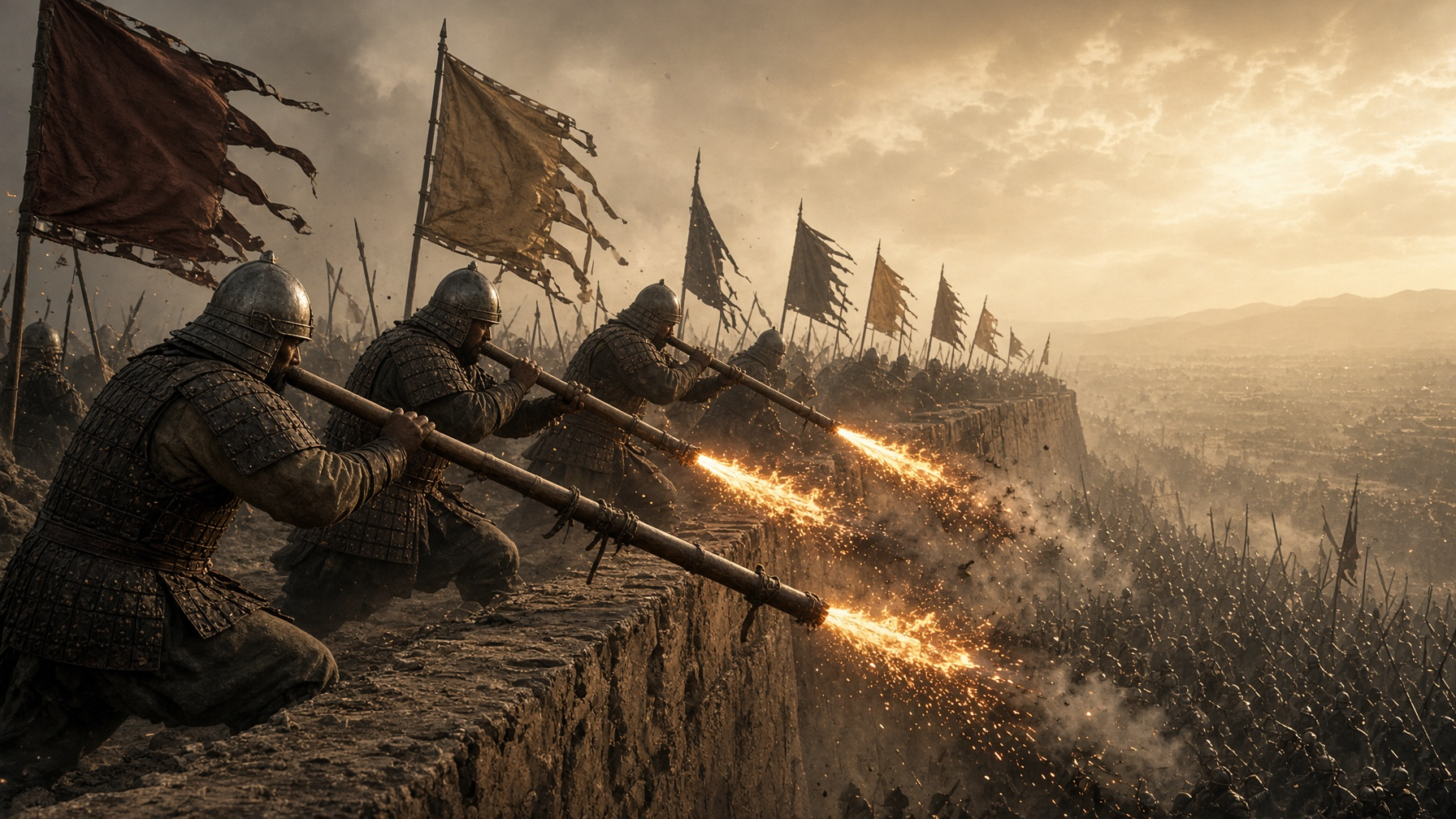
Fire lances on a Song fortress — flame, grit, and the first guns.
In 1044 the Northern Song court issued the Wujing Zongyao. It is the oldest surviving book to write down chemical formulas for gunpowder, used in bombs, smoke, and incendiaries.
At De’an in 1132, defenders used fire lances: tubes packed with powder, spitting flame at men on the wall. Over the next century the tube became metal, and the gun was born in China, not Europe.
13th century
Powder rides west
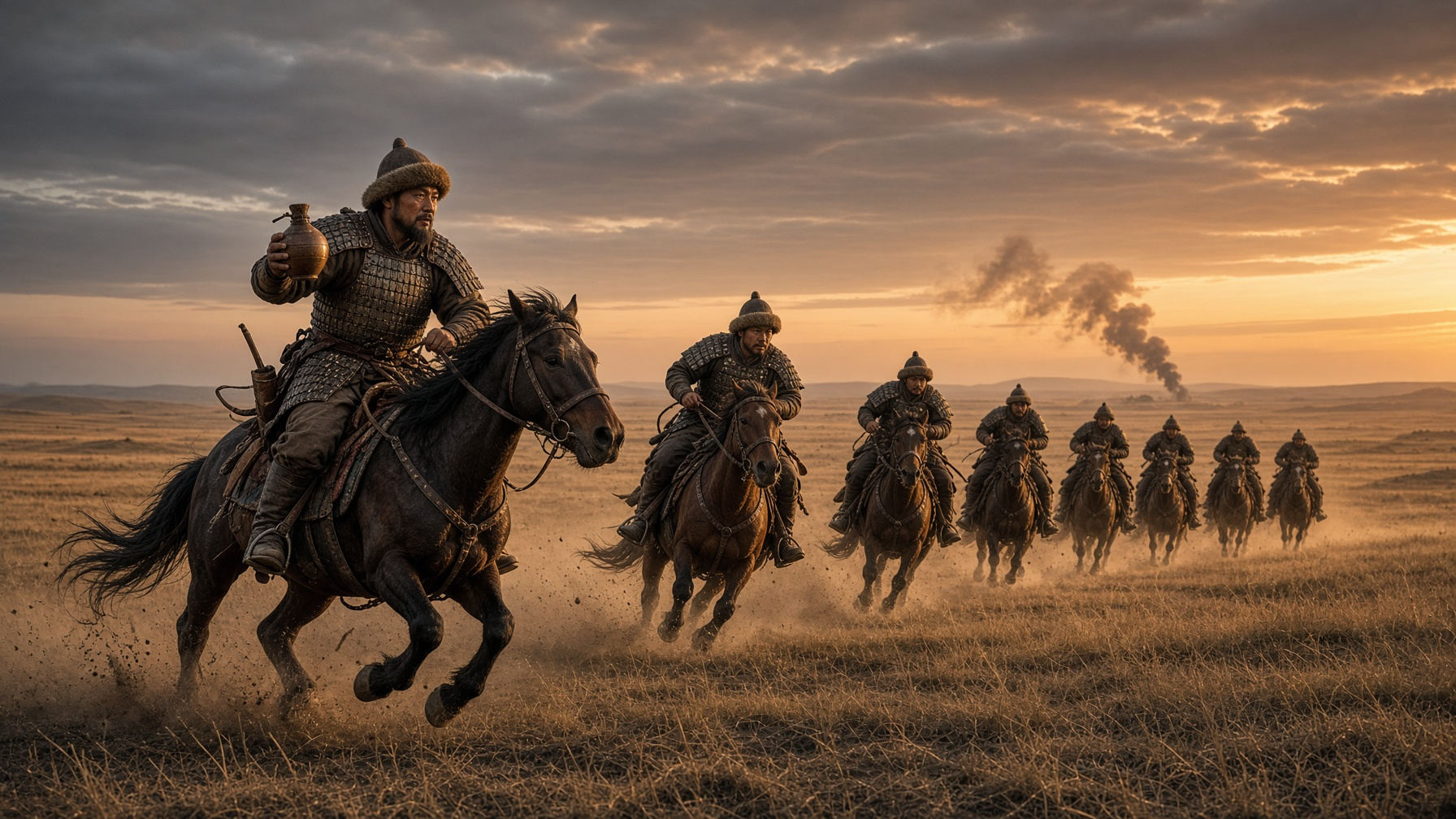
The steppe as a conveyor: powder riding west with the Mongol wars.
The Mongol conquests of the thirteenth century are the most plausible conveyor: Chinese engineers, siege bombs, and the recipe itself travelled into Central Asia, the Islamic world, and then Latin Europe.
Hasan al-Rammah, writing in Syria around 1270–1280, recorded powder recipes and rocket devices. In England, Roger Bacon’s Opus Majus (1267) alludes to a powder that cracks with thunder.
The gunpowder age
Walls, ships, and the empires that learned to feed a muzzle
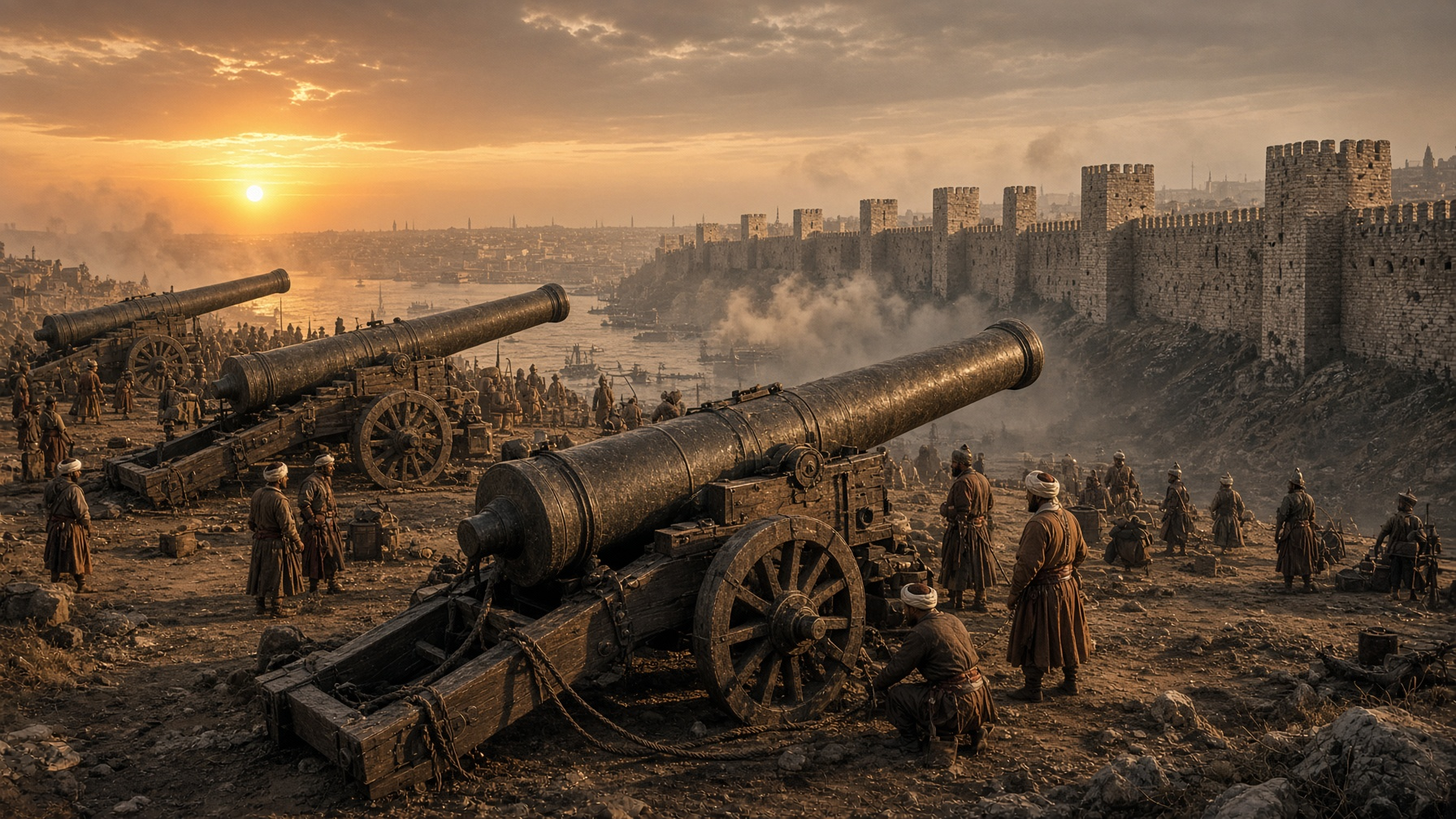
1453. The Theodosian walls meet bronze at a scale the medieval world had never seen.
On 29 May 1453 Constantinople fell to Mehmed II. Giant bombards had hammered the Theodosian walls that had stood for a thousand years. High medieval fortification was over.
Historians speak of the gunpowder empires — Ottoman, Safavid, Mughal — because the state that could mine saltpeter, cast bronze, and drill gunners could hold a continent.
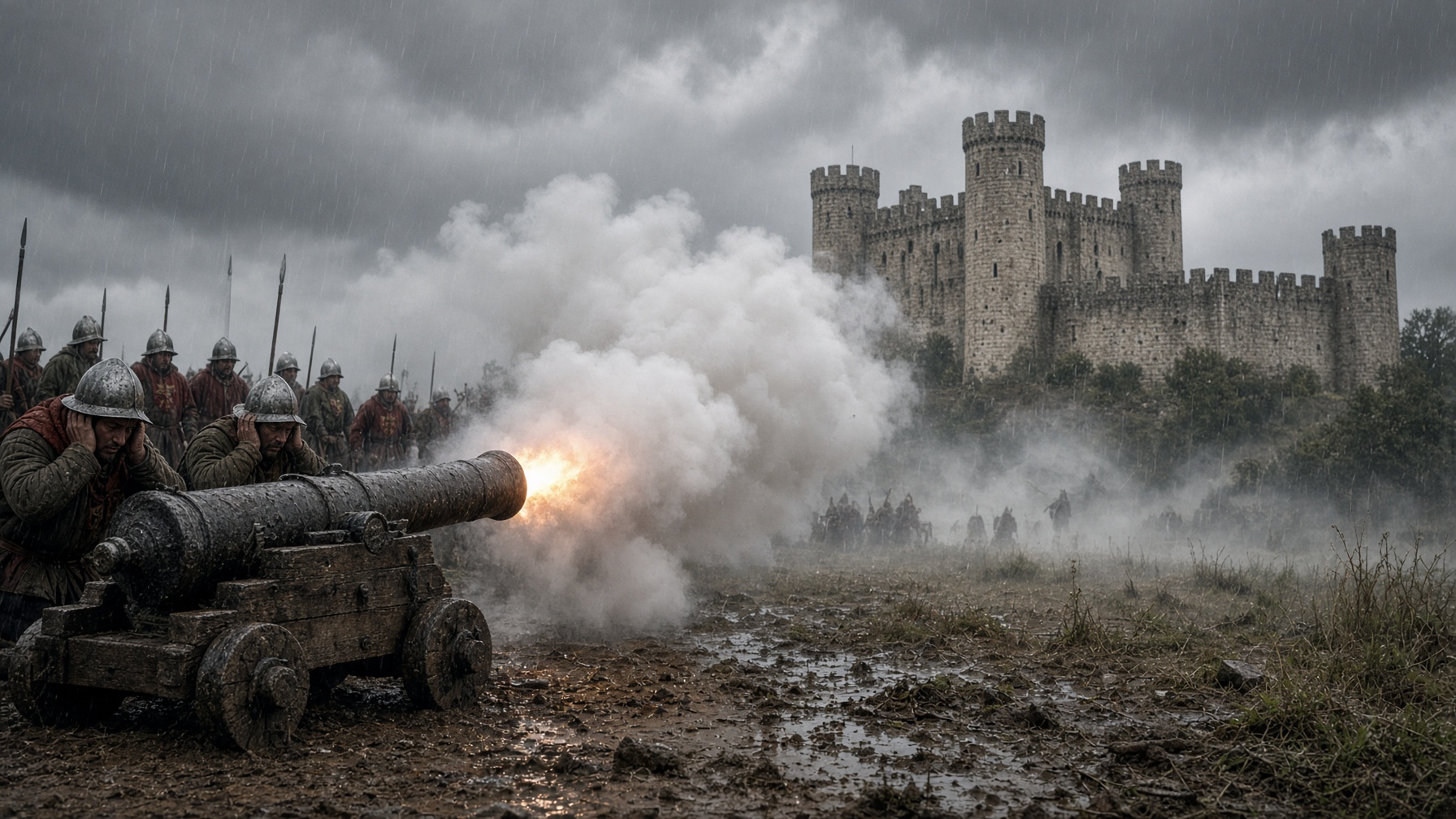
Europe learns the loud argument: bombards against stone.
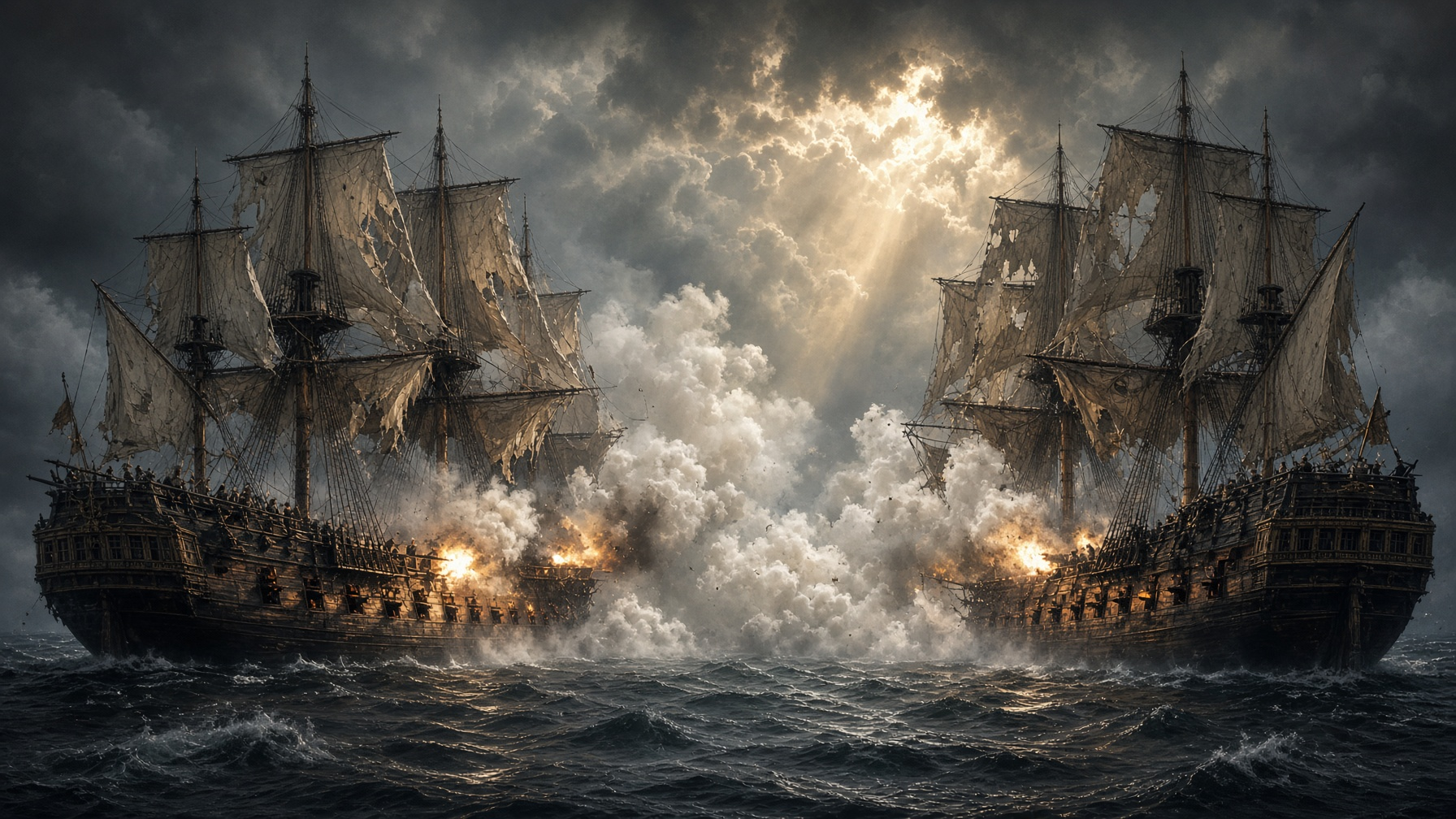
Broadsides: when navies became rolling magazines of black powder.
Watch
Two shots from the archive we never had
No camera stood in a Tang workshop or at Crécy. These films are reconstructed atmospheres — useful as mood, not as evidence.
The workshop flash
A ceramic bowl ignites in candlelight — the origin myth of huoyao, played as a single slow shot.
The bombard speaks
A wrought-iron bombard fires on a rain-wet field. For two centuries this was the sound of sieges ending.
What it is
Three substances, one idea
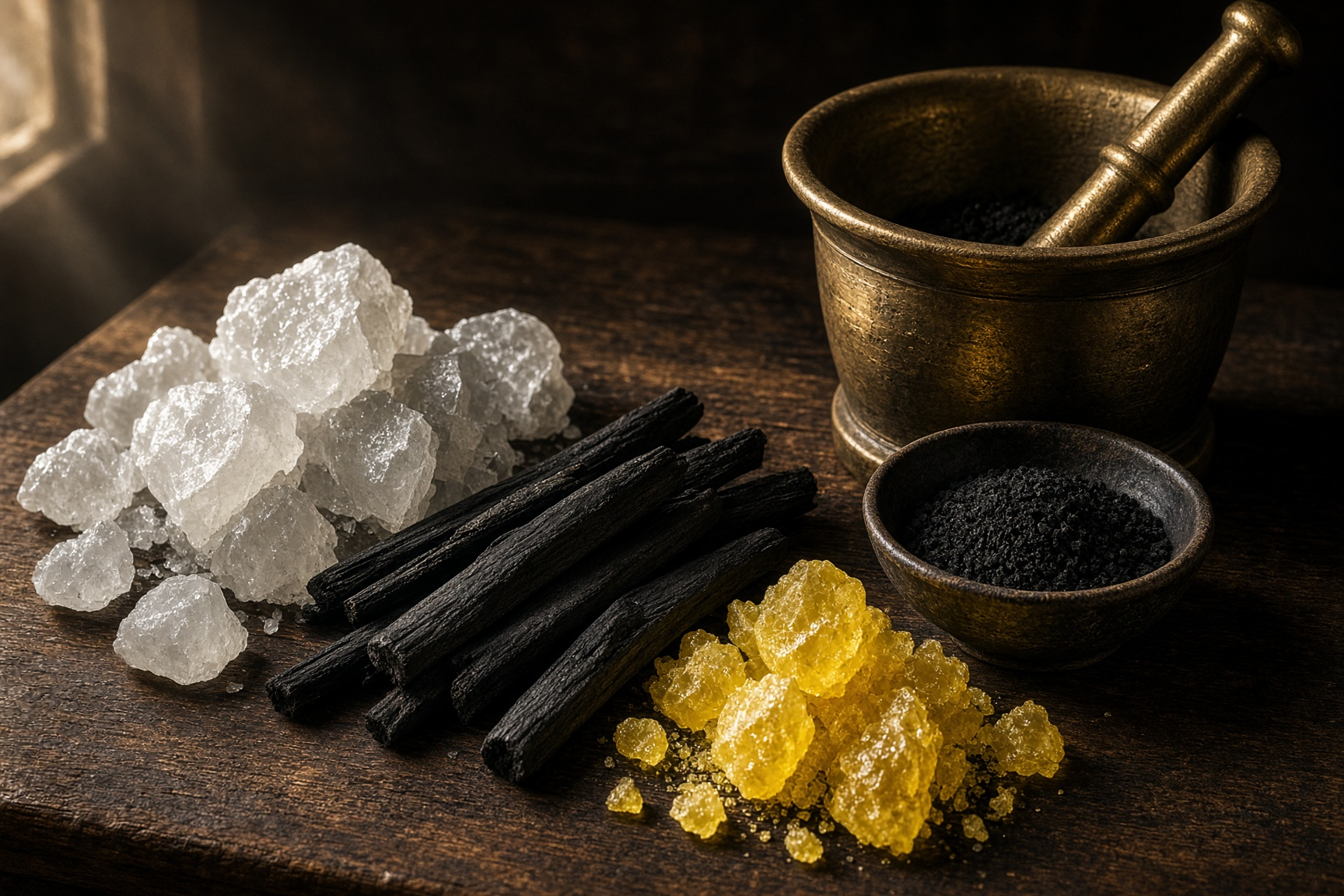
Saltpeter, charcoal, sulfur — three ordinary substances, one world-changing mixture.
Black powder is a low explosive: it deflagrates rather than detonates. This page does not publish working formulas or manufacturing steps. The historical mixture is an oxidizer, a fuel, and a substance that helps the fire start.
Saltpeter
Potassium nitrate
The oxidizer. It feeds the fire with oxygen that charcoal and sulfur would otherwise have to steal from the air — which is why the mixture can burn in a closed barrel.
Charcoal
Carbon fuel
The fuel. Willow, alder, and grapevine charcoals were prized in later European mills because a light, porous char burns cleanly and quickly.
Sulfur
The match
The accelerant. Sulfur lowers the temperature at which the grain will catch, and helps the flame front run through the mix.
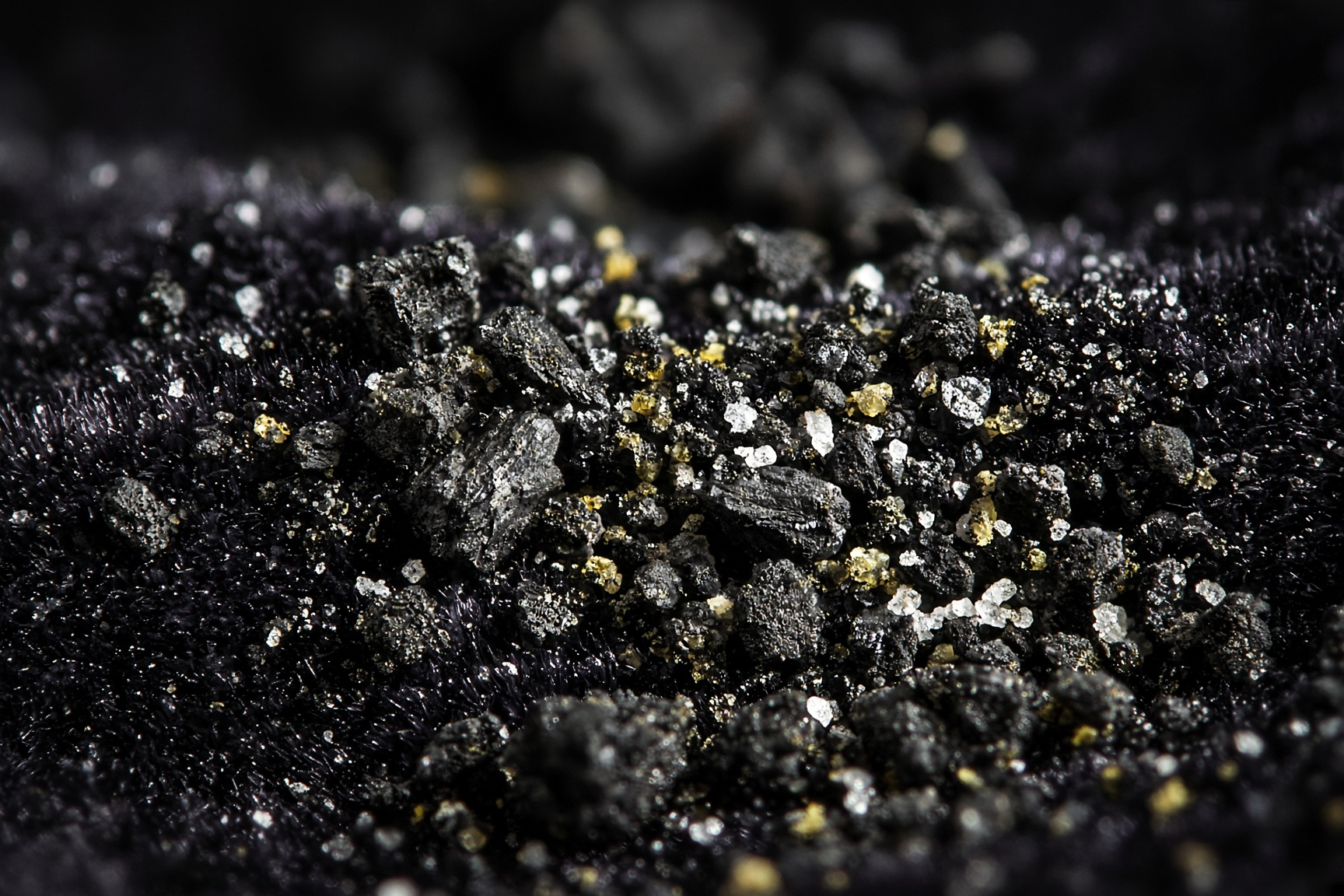
Black powder at the grain: charcoal, sulfur, and nitrate catching the light.
1884 · Poudre B
The day the battlefield went quiet of smoke

The 1880s laboratory that retired the smoke cloud.
In 1884 the French chemist Paul Vieille produced Poudre B, a nitrocellulose powder that burned with far less smoke and much more force. Alfred Nobel’s ballistite followed in 1887; Britain’s cordite in 1889. As a military propellant, black powder was finished.
Photographs
From this essay
Further reading
- Science and Civilisation in China, Vol. 5, Part 7
Joseph Needham
The foundational Western scholarly account of Chinese gunpowder and firearms. - The Gunpowder Age
Tonio Andrade
How China, Europe, and the rest of Eurasia lived through the same invention differently. - Wujing Zongyao (武經總要)
Zeng Gongliang, Ding Du, Yang Weide, 1044
Earliest surviving written chemical formulas for gunpowder, in a Song military encyclopedia. - Zhenyuan miaodao yaolüe
Daoist text, 9th century
The famous warning that heating sulfur, realgar, and saltpeter can burn hands, faces, and houses.